
Viktor

by Viktor

Rent Day From 1,000 Miles Away: A Remote Landlord’s 7-Step System for Collecting Rent and Handling Late Payments
October 9, 2026 in Real Estate Investing
Living near your rental, a late payment means a knock on the door. Living 1,000 miles away, it means a text, a bank balance to keep checking, and a deadline you can miss. Here is a 7-step system for owners of one to five doors that runs the same way every month and keeps you inside your state’s rules.
The misconception: “My lease says it, so I can charge it”
Many small landlords assume any late fee written into a signed lease can be collected. Not always. Some states set the numbers themselves. In Texas, a landlord can’t charge a late fee unless the fee is in a written lease, is “reasonable,” and rent is still unpaid two full days after the due date. For a building with four or fewer units, a fee of up to 12% of the monthly rent counts as reasonable. A landlord who breaks this rule owes the tenant $100, plus three times the improper fee, plus attorney’s fees (Tex. Prop. Code §92.019). In New York, a late fee can’t be charged until rent is more than five days late, and it’s capped at $50 or 5% of the monthly rent, whichever is less (N.Y. Real Prop. Law §238-a).
On an $1,800 house, that’s up to $216 in Texas but $50 in New York.
Step 1: Pick payment methods your state allows
Online rent collection is the obvious choice for a remote owner, but some states won’t let you make it the only option. California requires a landlord to allow at least one way to pay rent that is neither cash nor an electronic funds transfer, such as a check or money order (Cal. Civ. Code §1947.3). Texas requires landlords to accept timely cash payments unless the written lease requires a check, money order or other traceable payment. If you do take cash, you must give a written receipt and record the payment (Tex. Prop. Code §92.011).
Interpretation, not fact: for a remote owner, a good default is online payment plus a mailed check or money order to a fixed address, with the lease saying “no cash.” That satisfies both rules above.
Step 2: Use a rent platform or a dedicated account, not a personal wallet
The CFPB has warned that money left sitting in a nonbank payment app may not be covered by federal deposit insurance if the company fails (CFPB consumer advisory). Route rent to a bank account used only for the rental, and move app balances out the same day.
On taxes: payment apps file Form 1099-K only when payments to you top $20,000 and 200 transactions in a year, a threshold Congress restored retroactively (IRS). A single-family rental will almost never reach it, but rental income is reportable either way, and advance rent counts in the year you receive it (IRS Publication 527). Our guide to the 2026 1099 changes covers the forms you send to contractors.
Step 3: Write the calendar into the lease
Put four dates in plain words: the due date, the last day before a late fee applies, the fee amount, and the date you start formal notice. Example for a Texas house at $1,800 rent: due on the 1st; late fee of $90 (5%) if any rent is still unpaid at the start of the 4th; written notice process begins on the 6th. This is an illustrative schedule, not legal advice for your lease.
Step 4: Automate reminders, then make one human contact
Set autopay invitations and an automated reminder three days before the due date. On the first late day, call or text once, politely: “Rent didn’t come through. Is everything OK, and when can you pay?” Many late payments are a timing problem, not a refusal. Log the date the tenant promises.
Step 5: Know your state’s notice rules before you need them
Formal notice is where remote landlords make costly mistakes. In Florida, a landlord can end the lease for unpaid rent only after a written demand gives the tenant 3 days, not counting weekends and court holidays, to pay or move out. The statute gives the wording, and the lease can’t waive it (Fla. Stat. §83.56(3)-(4)). Other states use different periods and delivery rules. Save a notice template from your state’s courts or a local attorney now, and know who could deliver it locally.
Step 6: Be careful with partial payments
Taking part of the rent can affect your rights. Florida says accepting partial rent doesn’t waive the landlord’s right to act. But if you take it after posting the 3-day notice, you must do one of three things: give a receipt showing the balance and the agreed due date, deposit the money with the court when you file, or post a new notice for the new amount (§83.56(5)(a)). Rule of thumb: no partial payment after a formal notice until you’ve checked your state’s rule.
Step 7: Keep one ledger and review it on the 10th
Each month, record the amount due, the amount paid, the date paid, any fee and any notice sent. Ten minutes on the 10th tells you whether this month is fine, a one-time slip, or the start of a pattern. If you hire a manager later, ask to see their late-rent timeline in writing. Our guide to hiring a property manager lists more questions to ask.
Your Monday checklist
- Look up your state’s late-fee rule (grace period, cap, lease requirements).
- Confirm your payment options meet any “non-electronic option” or cash rule.
- Open or confirm a bank account used only for the rental.
- Rewrite the lease’s rent clause with four plain dates.
- Turn on autopay invitations and a reminder 3 days before rent is due.
- Save a state-specific notice template and line up someone local who can deliver it.
- Write your partial-payment rule down before you need it.
- Put a 10-minute ledger review on the 10th of every month.
Pair this with solid tenant screening and a clear move-out process, and see how to manage an out-of-state property yourself.
This article is for general education only and is not legal, tax or financial advice. Landlord-tenant rules vary by state and city and change over time; confirm current rules with your state’s official sources or a licensed attorney before changing a lease or sending a notice. Statute details are as of October 2026. The featured image is an AI-generated illustration and does not show a real property.
by Viktor

The Move-Out Deposit Clock: A Remote Landlord’s 7-Step System for Inspections and Deposit Returns
October 8, 2026 in Real Estate Investing
Most deposit fights aren’t won by whoever is right. They’re won by whoever can prove it. Living 1,500 miles away, you can’t stop by and point at a burn mark in the counter, so you need photos, dates and paperwork. Here’s a system that starts on move-in day, not the day the keys come back.
The deadline is shorter than most owners think
Each state sets its own deposit rules, and the clock usually starts when the tenant leaves. Three big rental states show the range:
- Texas: refund the deposit within 30 days after the tenant surrenders the unit, with a written, itemized list of any deductions (Tex. Prop. Code 92.103, 92.104). The clock doesn’t start until the tenant gives you a forwarding address in writing (92.107). Miss the 30 days and the law presumes bad faith. A landlord who withholds in bad faith can owe $100, plus three times the amount wrongly kept, plus the tenant’s attorney’s fees (92.109).
- Florida: if you’re keeping nothing, return the deposit within 15 days. If you plan to deduct, send a written notice of your claim within 30 days, by certified mail or by e-mail as the statute allows. The tenant then has 15 days to object. Miss the 30-day notice and you lose the right to claim against the deposit, though you can still sue for damages separately (Fla. Stat. 83.49(3)).
- California: send an itemized statement within 21 days after the tenant leaves. Include copies of invoices or receipts for the repair and cleaning charges, and use a good-faith estimate if the work isn’t finished yet (Cal. Civ. Code 1950.5).
Own elsewhere? Read your state’s statute before your first move-out, not a forum post.
California now requires the photos
Elsewhere photos are smart practice; in California they’re the law. Under AB 2801, landlords must photograph the unit immediately before or at the start of any tenancy that began on or after July 1, 2025. Since April 1, 2025, landlords must also photograph the unit after the tenant returns possession but before any repairs or cleaning they plan to deduct for, and again after that work is done. They go to the tenant with the itemized statement. California also caps most deposits at one month’s rent. There’s an exception that allows two months for an owner who is a natural person, or an LLC whose members are all natural persons, with no more than two rental properties and four units in total (AB 12 summary, SF.gov).
A common misconception: “They lived there five years, so the carpet is on them”
The opposite is closer to true. Normal wear and tear can’t come out of the deposit. Texas defines it as deterioration from intended use, including breakage or malfunction from age (92.001(4)), and California bars claims for wear and tear or for conditions that existed before the tenancy. Interpretation, not fact: the longer someone has lived in the unit, the more of the change you see counts as ordinary wear. Faded paint and a traffic path in an eight-year-old carpet are your cost. A pet stain or a hole punched through a door generally isn’t. Your move-in photos are what let you tell these apart.
The 7-step remote inspection system
- Shoot a move-in video with the tenant in it, or on a call with them. Walk room by room: walls, floors, oven, fridge, under sinks, screens, blinds and both sides of every door. Say the date and address out loud at the start. If an agent or handyman does the walk, send a written shot list.
- Add a signed condition checklist. The tenant initials each room and notes existing damage within a few days. Store video, photos and checklist in one folder named by address and lease date.
- Put the move-out rules in writing early. When notice arrives, send a short letter: cleaning standard, key return, a written forwarding address (it starts the Texas clock), and how to book an inspection. California requires you to offer a pre-move-out inspection, where the tenant gets a list of problems to fix before leaving.
- Get someone on site within 24-48 hours of key return. Use your property manager, a handyman you’ve vetted, or a local inspector paid by the job. Same rooms, same order as the move-in video, before any cleaning or repairs.
- Compare the two videos side by side and tag each difference. Mark each item as “wear and tear,” “damage” or “unclear.” When in doubt, mark it “unclear” and leave it off the bill. A thin claim invites a dispute that costs more than the item.
- Price each damage item from a real invoice. Get one bid per item and keep the receipt. If the work isn’t finished by the deadline, send a good-faith estimate where your state allows it, then follow up with the final invoice. California gives you 14 days after the repair is completed.
- Put a deadline on your calendar the day notice arrives, then mail the statement and refund a week early, using a trackable method. Keep proof of mailing with the inspection files.
What it costs, roughly
Illustrative, not a quote: a local helper might charge $75-$150 for a 45-minute photo walk. On a $1,800 deposit, one disputed $400 deduction that you lose in Texas small-claims court on bad-faith grounds could cost you $100 plus 3 × $400 = $1,300, plus the tenant’s attorney’s fees. Budget the walk-through as a turnover cost in your repair reserve plan.
If you use a property manager
Ask: who shoots move-in and move-out media, and where is it stored? Who sends the deduction letter, and when? Can you review deductions over a set amount first? Vague answers are a reason to revisit how you hired them. Good move-in records pair with solid tenant screening. More checklists are in our resources and tools section, and the full self-management playbook is here.
Monday checklist
- Find your current tenant’s move-in photos. If you don’t have any, schedule a “maintenance check” walkthrough video now.
- Write down your state’s deposit deadline and notice method.
- Line up one local person who can do a 48-hour move-out walk.
This article is general educational information, not legal, tax or financial advice. Security-deposit rules differ by state and city and change over time. Check the current statute or a local attorney before deducting from a deposit. Statutes checked October 8, 2026. The featured image is an AI-generated illustration and does not show a real property.
Related: A remote landlord’s 7-step rent collection and late-rent system
by Viktor

How to Set the Rent on an Out-of-State Rental You Can’t Walk Through: A 6-Step Pricing Method
October 7, 2026 in Real Estate Investing
Pricing a rental is hard enough when you can drive past the competition. From another state, most owners fall back on one number from a rent-estimate website and hope. Too high and the house sits empty; too low and it rents in a day.
This is the six-step method we suggest for a single-family rental or small multi you manage from a distance.
Step 1: Build a comp sheet from leased rentals, not asking prices
Asking rents are what owners hope to get. Leased rents are what tenants actually paid. Ask your agent or property manager for leased comparables from the local MLS. Look for 5 to 10 homes with the same bedroom and bathroom count, within about a mile, rented in the last 60 to 90 days.
Write down five things for each one: rent, square footage, days on market, who pays which utilities, and the extras (garage, yard, washer/dryer, pets allowed). No leased data? Use current listings and note how long each has sat; 45 days on market means overpriced.
The remote fix: pay your handyman or agent a small fee to walk through two competing listings on a video call.
Step 2: Check the official baseline, and read it correctly
HUD’s Fair Market Rents are free for every metro area and county, by bedroom count. They are a useful sanity check, but two facts matter (fact, from HUD’s definition in 24 CFR 888.113):
- FMRs estimate the 40th percentile, not the average or the top of the market, for standard-quality units.
- FMRs are gross rents: rent plus the utilities a tenant pays.
A common mistake is treating the FMR as “market rent.” If the tenant pays $200 a month in utilities, the comparable rent figure is the FMR minus about $200. Our breakdown of the FY2027 Fair Market Rents explains how to look up your area.
Step 3: Take the market’s temperature
Two free federal numbers tell you whether you have pricing power right now:
- Vacancy. The Census Bureau reports a national rental vacancy rate of 7.3% in the second quarter of 2026, about the same as a year earlier (7.0%, not statistically different). Census also publishes rental vacancy rates by state and for the 75 largest metro areas. Look up yours.
- Rent growth. The BLS index for rent of primary residence rose about 2.7% from August 2025 to August 2026, while overall consumer prices rose about 3.4% (our calculation from the not-seasonally-adjusted U.S. city averages).
Interpretation, not fact: rents nationally are rising more slowly than general prices, and vacancy is not tight. In most markets that argues for pricing at the comps, not above them. A local metro with low vacancy may be different, which is why you check your own area.
Step 4: Do the empty-week math before you add $100
Here is an illustrative example, not a forecast. A house that rents for $1,800 a month earns about $59 a day ($1,800 × 12 ÷ 365).
- Pricing it $100 higher earns an extra $1,200 over a 12-month lease.
- If that higher price adds three weeks of vacancy, you lose about $1,240.
The break-even is roughly 20 extra empty days. Add the utilities and mortgage you carry while it sits, plus the risk of unnoticed leaks in an empty house, and the higher price often loses.
Step 5: List, then watch the first 10 to 14 days
Treat the first two weeks as a price test. Track inquiries, showings and completed applications. A rule of thumb many managers use (interpretation, not a law): if you get plenty of inquiries but no qualified applications, the issue is the listing, photos or screening criteria; if you get almost no inquiries at all, the price is the issue. Cut in one clear step, often 2% to 3%, rather than several small ones.
Keep pricing consistent. Advertise one rent and the same terms to everyone. The federal Fair Housing Act bars ads that indicate a preference based on protected characteristics, and offering different prices or “deals” to different applicants creates risk (see HUD’s Fair Housing Act overview). Your written screening criteria should be ready before the ad goes live.
Step 6: Price renewals with the law and turnover costs in mind
Three states cap annual increases statewide for many rentals (fact, from the official pages):
- Oregon: 9.5% for 2026 and 10% for 2027 (Oregon Office of Economic Analysis).
- Washington: 9.683% for 2026 and 10% for 2027, under RCW 59.18.700 (WA Department of Commerce).
- California: 5% plus local inflation, capped at 10%. For increases starting August 1, 2026 through July 31, 2027, that is 8.1% to 8.8% depending on the area (California Attorney General).
Each law has exemptions (California’s cap, for example, covers housing more than 15 years old and has rules for single-family homes), and cities can have their own rules. Many states also set notice periods for increases. Check the official page for your property’s location before sending a notice.
Interpretation, not fact: legal is not the same as smart. A good tenant who pays on time is worth a lot. Lose them and you pay for vacancy, cleaning, paint, leasing and the risk of a worse tenant. For many small owners, a renewal increase near local market growth keeps the house full and the math steady. Build those turnover costs into your reserve plan.
Your pricing checklist
- Get 5 to 10 leased comps (same beds/baths, within about a mile, last 60 to 90 days).
- Record rent, size, days on market, utilities and extras for each.
- Pay for a video walkthrough of two competing listings.
- Compare against your area’s Fair Market Rent, minus tenant-paid utilities.
- Look up your metro’s rental vacancy rate.
- Run the empty-week math before pricing above the comps.
- Track inquiries and applications for 10 to 14 days; adjust once, clearly.
- Check state and local rent caps and notice rules before any renewal increase.
New to managing from a distance? Start with whether out-of-state investing fits you, and if pricing and leasing are not tasks you want, see how to hire a property management company. Our resources and tools page has calculators for the numbers above.
This article is for general educational purposes only and is not legal, tax, financial or investment advice. Rent laws change and vary by state and city; confirm current rules with official sources or a qualified local professional before setting or raising rent. Featured image: AI-generated illustration, not a specific property.
Related: How to handle move-out inspections and deposit deadlines from another state
by Viktor

How to Vet a Handyman You’ve Never Met: A Remote Landlord’s 7-Point Check Before the First Job
October 6, 2026 in Real Estate Investing
When you own a rental two time zones away, your handyman is the person who actually touches your property. A good one keeps a small drip from becoming a water claim; a bad one leaves you with a half-finished job, a lost deposit or worse. The tricky part is that you usually hire this person without ever shaking their hand.
Here is a practical system for vetting a handyman or small contractor from another state. Do it before anything breaks, so you aren’t choosing someone in a panic at 2 a.m.
The misconception: “It’s a small job, so a license doesn’t matter”
Sometimes handyman work is unregulated, but the limits are narrower than most owners think, and they vary by state.
- Fact: In California, an unlicensed person can only do jobs under $1,000 (labor, materials and everything else combined), and only if the job needs no permit and the person hires no helpers. If any of those three conditions fails, a contractor’s license is required. The limit rose from $500 on January 1, 2025 (CSLB, AB 2622 bulletin).
- Fact: Texas has no general state handyman license, but plumbing and electrical work are licensed trades at the state level (Texas Plumbing License Law; TDLR electricians program), and cities can add their own rules.
- Fact: Florida’s statutory owner-builder disclosure warns that if an unlicensed contractor or their worker is injured on your property, “you may be held liable for damages,” and that the state licensing board may be unable to help you recover losses from an unlicensed contractor (Fla. Stat. 489.103).
Interpretation, not fact: the safe default for a remote owner is to treat “handyman” as fine for small, permit-free fixes (a running toilet, a sticking door, a new faucet cartridge), and to use a licensed trade for anything involving gas, wiring, new plumbing, roofing or a permit.
The 7-point check
1. Look up the license yourself
Don’t accept a photo of a license card; search the state board’s online lookup (for example, California’s CSLB license check) and confirm the name, the classification and that the license is active. If your state doesn’t license handymen, check the city or county instead. The FTC gives the same advice (FTC home improvement scam guide).
2. Get a certificate of insurance, with you on it
Ask for a certificate of insurance (COI) showing general liability and, if they have any employees, workers’ compensation. Ask their insurance agent to send it directly to you, and call the agent to confirm the policy is current. Calendar the expiration date.
3. Ask the “lead question” if your house was built before 1978
Under EPA’s Renovation, Repair and Painting (RRP) rule, work in a pre-1978 rental that disturbs more than 6 square feet of painted surface in a room (or more than 20 square feet outside), or any window replacement, must be done by an EPA lead-safe certified firm. Jobs in the same room within 30 days count as one job (40 CFR 745.83). The firm must also give the owner and the tenant EPA’s Renovate Right pamphlet before starting (40 CFR 745.84). EPA says the rule applies to rentals regardless of who lives there, and to property managers who do this work (EPA RRP program). In states that run their own EPA-authorized program, the state version applies. Search certified firms with EPA’s firm locator. More background in our lead-dust standard article.
4. Do a paid trial job
Before any big project, hire the candidate for a small, real task: replace a few smoke alarm batteries, re-caulk a tub, fix a dripping faucet. Ask for before-and-after photos and a short written note of what they saw. You learn how fast they respond and whether their photos are useful.
5. Check two references and one paper trail
Ask for two recent customers, ideally other landlords or property managers. Ask them: Did they show up on time? Did the final bill match the quote? Would you hire them again? Then search the business name with “complaint” or “scam,” as the FTC suggests.
6. Put it in writing, and pay in stages
For anything beyond a quick fix, use a short written agreement: name, address, phone, license number, scope of work, price, start and finish dates. The FTC warns against paying everything up front or in cash, notes that some states cap down payments, and advises never making the final payment until the work is done and you’re satisfied. A scammer who asks you to pull the permit is another red flag on the FTC’s list.
7. Get the paperwork for tax time
Collect a Form W-9 before the first payment, not in January. Whether you need to send a 1099 depends on how much you pay them and how; the reporting threshold changed for 2026, which we explain in our 1099 threshold article.
A simple way to run it from far away
An illustrative setup that works for one or two houses: one vetted handyman for small jobs, one licensed plumber, one electrician and one HVAC company, each with a pre-approved spending limit (say, $300 without calling you). Keep their license numbers, COI expiration dates and W-9s in one shared spreadsheet. Give your tenant the approved list. This plugs straight into the triage steps in our 2 a.m. repair-call playbook, and the repair line in your reserve plan covers the bills.
Monday checklist
- Look up your property’s state and city licensing rules for handyman vs. trade work, and note the dollar limit if there is one.
- Find two handyman candidates and verify each license (or local registration) online.
- Request a COI from each, sent by their insurance agent, and calendar the expiration dates.
- If the house is pre-1978, confirm at least one vendor is an EPA lead-safe certified firm.
- Book a small paid trial job and judge the photos and the communication.
- Collect a W-9 and set a written spending limit before the first real job.
- If you’d rather not manage vendors at all, read our guide on hiring a property management company, or see how to manage an out-of-state rental by yourself.
This article is for general educational purposes only and is not legal, tax, financial or investment advice. Licensing, insurance and lead-safety rules vary by state and city and can change; confirm the requirements for your property with the relevant agencies and consult qualified professionals before making decisions. Dollar figures in the example setup are illustrative, not quotes.
by Viktor
How Much to Set Aside for Repairs on One Out-of-State Rental: A Line-by-Line Reserve Plan
October 5, 2026 in Real Estate Investing
Most first-time out-of-state landlords budget for the mortgage, taxes, insurance and the property manager’s fee. Then a water heater fails in year two, the roof needs work in year four, and one bad month wipes out a year of cash flow. The fix is not a rule of thumb. It is a simple reserve plan built from the actual parts of your house and how old they are.
This guide walks through that plan for a single-family rental, with real survey numbers and a worked example you can copy.
Two buckets, not one
Split your “repairs” money into two separate buckets:
- Routine repairs and maintenance — the clogged drain, the broken garbage disposal, the furnace tune-up, the leaky faucet. These happen every year and vary a lot.
- Capital expenses (capex) — big items that wear out on a fairly predictable clock: roof, furnace, air conditioner, water heater, appliances, flooring.
Routine repairs come out of monthly cash flow. Capex needs a savings account that fills up slowly before the item fails.
What owners of single-family rentals actually spend on repairs
Fact: The Census Bureau and HUD’s 2024 Rental Housing Finance Survey asks owners what they spent to run their property for a year. In our own weighted tabulation of the public-use file, limited to single-unit rental properties that reported repair and maintenance costs:
- About 9 in 10 spent something on repairs and maintenance during the year.
- Among those, the median was $2,000.
- One in four spent $4,500 or more, and one in ten spent $8,900 or more.
This is a small sample (154 properties), so treat the figures as a rough guide, not a precise national average. Still, the spread is the lesson: a “normal” year is around $2,000, and a bad year can be four times that.
How long the big items last
Fact: The National Association of Home Builders’ Study of Life Expectancy of Home Components (2007, so treat it as a ballpark) lists typical lifespans of about 20 years for asphalt shingle roofs, 10–11 years for gas or electric tank water heaters, 15–20 years for furnaces, 10–15 years for air conditioners, 9 years for dishwashers, 13 years for refrigerators and 8–10 years for carpet. ENERGY STAR’s replacement guidance says to consider replacing an air conditioner or heat pump older than 10 years and a furnace or boiler older than 15.
What the big items cost
Fact: The 2023 American Housing Survey reports these median homeowner spending figures per project (2021–2023): roofing $10,000, HVAC $5,500, kitchen remodels $8,000, flooring $3,000, doors and windows $2,800, and water heater/dishwasher/disposal $800.
Interpretation, not fact: These are medians for homeowners, and they include partial jobs and do-it-yourself work (the same survey says 36% of projects were DIY). A remote landlord paying a contractor for a full replacement should plan for more than the median. That is why the example below uses higher numbers.
A worked example: one 25-year-old, 3-bedroom house
Divide each item’s replacement cost by its lifespan to get a monthly set-aside. Costs below are illustrative, not quotes — replace them with local bids.
| Item | Illustrative cost | Lifespan used | Per month |
|---|---|---|---|
| Asphalt roof | $12,000 | 20 yrs | $50 |
| Furnace | $5,500 | 15 yrs | $31 |
| Central AC | $5,500 | 12 yrs | $38 |
| Tank water heater (installed) | $1,800 | 10 yrs | $15 |
| Appliances (fridge, range, dishwasher) | $3,000 | 11 yrs | $23 |
| Flooring and full paint | $4,500 | 8 yrs | $47 |
| Windows, doors, exterior, driveway | $6,000 | 25 yrs | $20 |
| Total capex reserve | about $224 |
Add routine repairs. Using the survey’s $2,000 median works out to about $167 a month. Together, that is roughly $390 a month, or about $4,700 a year, for this one house. On a house renting for $1,800, that is more than a fifth of the rent — far more than many pro formas assume.
Adjust for age: the step most people skip
A monthly set-aside assumes every item is brand new. Yours probably are not. If the water heater is already 11 years old, it is not “$15 a month” — it is “$1,800 sometime soon.” So:
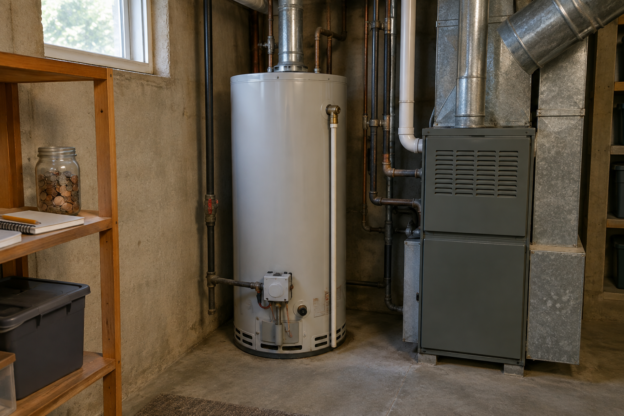
- Find the age of each big item. The home inspection report usually lists them. If not, ask your manager or handyman to photograph the data plate on the furnace, AC condenser and water heater; the manufacture date is often coded in the serial number.
- Flag anything at or past its lifespan. Fund that full replacement cost up front, or plan to.
- Keep a starting cushion. Interpretation: a common, conservative approach is to hold at least the cost of your single most expensive likely failure (often the HVAC system or roof) before you close, on top of normal reserves.
Why this matters more when you live far away
Interpretation, not fact: Remote owners pay a “distance premium.” You can’t shop three bids in person, emergency calls cost more, and a failure during a vacancy can go unnoticed. Insurance generally pays for sudden damage, not equipment that simply wore out — check your own policy wording. A funded reserve lets you say yes to the right fix quickly instead of the cheapest patch. See our 2 a.m. repair-call playbook for how to handle the urgent ones.
Your Monday checklist
- Open a separate savings account just for this property’s reserves.
- List the seven big items above with their age and a local replacement estimate.
- Calculate your monthly capex number and set an automatic transfer on rent day.
- Add a routine-repair line of at least $150–$200 a month for one house.
- Ask your manager for photos of every equipment data plate and a yearly condition report (our guide on hiring a property management company covers what to ask for).
- Do the seasonal maintenance that stretches lifespans — start with our October checklist.
- Re-run the numbers every January and before you buy the next property. Our calculators and tools can help, and is out-of-state investing for you? walks through the bigger picture.
This article is for general educational purposes only and is not financial, tax, legal or investment advice. Costs and lifespans vary by property, climate and market; get local bids and consult qualified professionals before making decisions. Survey figures are Remote Real Estate’s own tabulation of Census Bureau public-use data and are subject to sampling error.
by Viktor

Screening a Tenant You’ll Never Meet: A Remote Landlord’s 8-Step System
October 2, 2026 in Real Estate Investing
When your rental is 800 miles away, you may never shake hands with the person who signs the lease. That’s fine. But it does mean the screening has to do the work your gut would normally do at a showing.
Here’s a step-by-step system a one-to-five-door owner can run from a laptop. It treats every applicant the same way and catches the most common fakes.
Why this matters more than it used to
Fact: In a National Multifamily Housing Council survey of 75 large apartment operators (Nov. 2023–Jan. 2024), 93.3% said they had seen fraud in the past year. Of those, 84.3% had seen fake pay stubs or employment references, and 70% had seen identity theft or fake IDs. About a quarter of their bad debt was tied to fraudulent applications.
Fact: The screening reports have problems too. The CFPB received about 26,700 tenant-screening complaints from January 2019 through September 2022. Its 2022 snapshot describes records that belonged to someone else, outdated items, and eviction filings shown without their outcome. In 2023 the CFPB and FTC settled with TransUnion’s rental screening unit over eviction-record accuracy, with $11 million in consumer redress and a $4 million penalty.
Interpretation, not fact: the NMHC numbers come from big operators, but the same fake pay stub templates are online for anyone to use. A small owner who never meets applicants has fewer chances to notice something is off. The cost runs both ways: approving a fake, or rejecting a good applicant over a report error.
Step 1: Write your criteria before you list
Put your standards on one page and give that page to every applicant: minimum income, credit approach, rental history, pets, occupancy. Use the same page every time. The Fair Housing Act bars discrimination based on race, color, religion, sex, national origin, familial status and disability. Many states and cities add more protected categories, such as source of income. Written criteria applied the same way to everyone are your best protection.
The FTC’s landlord guidance also warns that a blanket “no criminal record” policy may violate the Fair Housing Act. Check your state and city rules on criminal history before you write that line.
Step 2: Check your state’s application-fee rules
Some states cap screening fees. California’s Civil Code 1950.6, for example, limits the fee to your actual out-of-pocket cost. The ceiling started at $30 per applicant and adjusts each year with inflation. California also bars charging the fee when no unit is available.
Step 3: Verify identity on a video call
- Schedule a 10-minute video call. Ask the applicant to hold their photo ID next to their face, and confirm it matches the application.
- Use a screening service where the applicant enters their own details and consents online. That way you never handle Social Security numbers by email.
- When the report comes back, check that the name, date of birth and past addresses match. Name-only matches are a known source of wrong records.
Step 4: Verify income at the source, not from the paper
Fake pay stubs look perfect. So check the source:
- Look up the employer’s main phone number yourself and call HR to confirm employment. Don’t use the number printed on the stub.
- Ask for two months of bank statements and compare the deposits with the stubs.
- Do the math the same way for everyone. Illustrative example: with rent at $1,600 and a 3x income rule, you need $4,800 a month in verified gross income. That’s a common rule of thumb, not a legal standard.
Step 5: Read the report, not just the score
Open the full report. If you see an eviction filing, check the outcome. A filing that was dismissed or settled is not the same as a judgment. If a record looks wrong (wrong middle name, a state the applicant never lived in), ask the applicant before you decide.
Step 6: Call the landlord before the current one
A current landlord may give a glowing reference just to get a problem tenant out. The previous landlord has no reason to. Before you call, check the county property records (search by address) to make sure the “landlord” actually owns the home.
Step 7: Decide, and send the right notice
Here’s a common mistake: thinking only a denial needs a notice. Under the FCRA, as the FTC explains, you owe an adverse action notice any time a consumer report played even a small part in a less favorable decision. That includes requiring a co-signer, a larger deposit or higher rent. The notice must include:
- the screening company’s name, address and phone number;
- a statement that the company didn’t make the decision and can’t explain it;
- the applicant’s right to dispute the report and to get a free copy if they ask within 60 days.
If you used a credit score, you also have to disclose the score, its range and source, and the key factors that hurt it. Oral notices are allowed, but the FTC says written notices are best practice because they give you proof.
Step 8: Store it safely, then shred it
Keep the application, the report and your notes in one folder per applicant. When you no longer need them, dispose of them securely. The FTC says to shred paper and delete electronic files so they can’t be reconstructed.
Your Monday checklist
- Write a one-page screening criteria sheet and save it as a PDF.
- Look up your property state’s application-fee and criminal-history rules.
- Pick a screening service with applicant-entered data and built-in adverse action letters.
- Add a 10-minute ID video call to your process.
- Verify employment through independently found phone numbers, and check bank deposits.
- Call the prior landlord and confirm ownership in county records.
- Send a written notice for every denial, co-signer request or higher deposit.
- Set up a secure folder, plus a reminder to shred or delete old files.
Want someone else to run this? Read our guide on how to hire a property management company and ask any candidate to walk you through their screening steps. Managing on your own? Start with how to manage out-of-state real estate by yourself, keep our 2 a.m. repair-call playbook handy for after move-in, and use the calculators on our resources and tools page to set rent before you screen.
This article is for general educational purposes only and is not legal, tax, financial or investment advice. Screening, fee and fair-housing rules vary by state and city. Consult a qualified attorney or professional about your specific situation. Cost and income figures are illustrative.
Related: How much to set aside for repairs on one out-of-state rental
by Viktor

The 2 a.m. Repair Call: A Remote Landlord’s Playbook for Leaks, Gas Smells and No-Heat Nights
October 1, 2026 in Real Estate Investing
Your phone buzzes at 2:07 a.m. It’s your tenant, 900 miles away: “Water is coming through the kitchen ceiling.” What you do in the next ten minutes decides whether this costs a plumber’s visit or an insurance claim, a ruined weekend and an unhappy tenant.
Most small landlords who manage from another state make this plan in the middle of the emergency. This post helps you make it on a quiet Monday instead.
Why the first hour matters: three numbers
- Water is the expensive one. From 2019 to 2023, water damage and freezing caused 1.50 claims per 100 insured homes per year, and the average claim paid was $15,400, according to ISO data published by the Insurance Information Institute. (These figures are for owner-occupied homeowners policies, not landlord dwelling policies, but the plumbing behaves the same.)
- Mold starts on a clock. The EPA says water-damaged areas and items should be dried within 24 to 48 hours to prevent mold growth.
- “Life-threatening” means 24 hours. In HUD’s NSPIRE inspection standards, life-threatening deficiencies in public and HUD multifamily housing must be dealt with within 24 hours. That rule doesn’t reach most private single-family rentals, but it’s a useful benchmark for what counts as urgent.
Sort every call into one of four buckets
Interpretation, not fact: this triage is our suggested framework, not a legal standard. Write it down and share it with your tenant and whoever answers your phone.
- Call 911 first. You come second. Gas smell, fire, smoke, a carbon monoxide alarm going off, sparking outlets or wiring. The tenant should get out and call from outside. For gas, the federal pipeline safety agency (PHMSA) says to leave on foot right away, not to search for the leak, not to flip switches or start a car, and to call 911 and the gas company from a safe place. Your only job is to tell them to get out. Don’t troubleshoot over the phone.
- Tonight. Water that’s actively leaking, sewage backing up, no heat in freezing weather, a door or window that won’t lock. Shut off the source tonight and send someone out tonight.
- Within a few days. No hot water, a dead fridge, a toilet that won’t stop running when there’s a second bathroom. These are still serious. Texas, for example, puts hot water of at least 120°F on the same list as health and safety conditions (Tex. Prop. Code 92.052).
- Routine. A dripping faucet, a sticky closet door, a burned-out bulb. Log it and schedule it.
Your state sets the repair clock, not your lease
Every state has its own rules for how fast you have to fix problems that affect health or safety. Two examples:
- Texas: once a tenant gives proper notice of a condition that materially affects health or safety, the law presumes seven days is a reasonable time to fix it. That can be rebutted based on how severe the problem is and whether materials and labor are available (Tex. Prop. Code 92.056).
- California: if a landlord doesn’t fix conditions that make a unit untenantable within a reasonable time, the tenant can repair them and deduct up to one month’s rent, no more than twice in 12 months. A tenant who acts after 30 days is presumed to have waited long enough, and the statute allows shorter notice “if all the circumstances require” it (Cal. Civ. Code 1942).
A common mistake: believing that a slow-but-legal response is good enough. These deadlines are the outer limit before tenants get legal remedies. The water in your ceiling won’t wait seven days, and neither will the mold. Look up your own state’s statute, or ask a local attorney or property manager, before you need it.
The 2 a.m. script
- Safety question first: “Is anyone hurt? Do you smell gas or see smoke or sparks?” If yes, tell them to get out and call 911.
- Stop the source: walk the tenant to the shutoff, whether that’s the main water valve, the valve under the fixture, or the water heater’s cold-water valve. This works much better if you already sent them a photo of where it is.
- Protect electrics: if water is near outlets or the panel, tell them to stay clear and wait for a pro. Don’t coach someone through electrical work.
- Get photos and video right away, before cleanup starts. Your insurer will want them.
- Dispatch your first-call vendor, using an approval limit you set ahead of time.
- Follow up in writing the same night: what happened, who’s coming, and when. That message is your record.
What to set up this week (Monday checklist)
- Find and photograph every shutoff: main water, gas meter, electrical panel, water heater. Tag them, then put the photos in your lease packet and a shared folder.
- Build a three-deep vendor list for plumbing, HVAC, electrical, water restoration and locksmith. For each, ask whether they answer after hours and what an after-hours visit costs. Our guide to hiring a property management company covers the same vetting questions.
- Set a pre-approved emergency limit, written down, that your manager or handyman can spend without calling you. Example only: “Up to $750 to stop active damage, then call me.”
- Give tenants a one-page emergency sheet with the four buckets, your after-hours number, the shutoff photos, and “call 911 first” in bold.
- Add cheap early warning: leak sensors under sinks and next to the water heater, and a thermostat that alerts you when the temperature drops. Our October winterizing checklist covers freeze protection.
- Read your policy’s water and vacancy terms and save your insurer’s claims number in your phone.
- Look up your state’s repair statute and note the timelines next to your vendor list.
If you’d rather never take the 2 a.m. call yourself, that’s a big reason to hire help. See how to manage an out-of-state rental by yourself and whether out-of-state investing fits you to decide where your line is.
This article is for general educational purposes only and is not legal, tax, insurance, financial or investment advice. Landlord-tenant laws vary by state and city and change over time; dollar figures are illustrative or drawn from the cited aggregate data, not quotes. For emergencies involving gas, fire, smoke or carbon monoxide, call 911. Consult a qualified local professional about your specific situation.
Related: Screening a tenant you’ll never meet: a remote landlord’s 8-step system
by Viktor
Your Out-of-State Rental’s October Checklist: Furnace, Pipes and Alarms Before the First Freeze
September 30, 2026 in Real Estate Investing
If your rental is 800 miles away, the first cold snap is not a weather story. It is a phone call. A furnace that will not light, a pipe that splits in an outside wall, a smoke alarm chirping at 3am because its battery is dying. October is the cheapest month to prevent all three, because the fixes can still be booked, not rushed.
Here is a plain checklist for owners of one to five doors who manage from another state.
Why October, in numbers
- Water damage and freezing caused claims at about 1 in 60 insured homes a year. The average claim was $15,400 (2019–2023). This comes from ISO data published by the Insurance Information Institute. The data covers homeowner policies, not landlord (dwelling) policies, so read it as a rough guide.
- Heating equipment was the second leading cause of home fires from 2019 to 2023. That works out to about 65,000 fires, 430 deaths and $1.1 billion in direct damage a year, according to the National Fire Protection Association.
- Carbon monoxide not linked to fires kills more than 400 Americans a year. It also sends more than 100,000 to the emergency room, per the CDC.
Step 1: Book the heating check now, not in December
ENERGY STAR recommends a yearly pre-season check-up. It says to check the heating system in the fall, because contractors get busy once winter arrives. The U.S. Fire Administration agrees: yearly professional cleaning and inspection.
From a distance, the job is less about the furnace and more about getting proof:
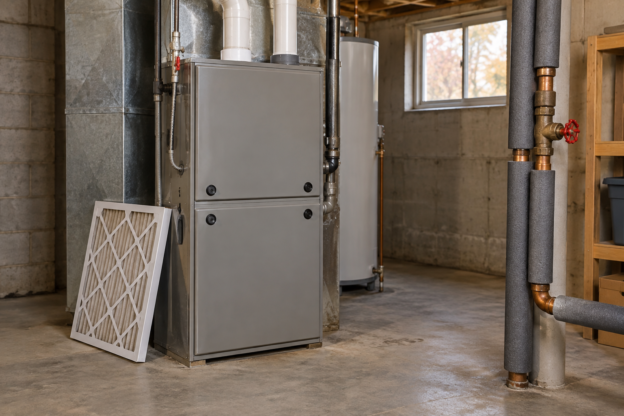
- Ask the technician for a written report plus photos. You want the filter, the burner or heat exchanger, the flue connection and the data plate (for the equipment’s age).
- Ask them to write down the age of the unit and anything they would plan to replace within 2–3 years. That note is your capex budget.
- Give the tenant the entry notice your lease and state law require, with two time windows.
Filters are the other half. ENERGY STAR says to inspect, clean or change filters monthly during heavy use. Interpretation, not fact: tenants rarely do it, so ship filters on a schedule or add a swap to every handyman visit.
Step 2: Protect the pipes, and know what your policy really says
The American Red Cross says that if a home will be empty in cold weather, the heat should stay on at no lower than 55°F. That matters most for holiday travel and winter turnovers.
The common mistake: assuming insurance will cover a burst pipe no matter what. Landlord policies are usually “dwelling” forms (DP-1, DP-2, DP-3), and they have limits on vacancy. The North Carolina Department of Insurance describes named-peril dwelling forms that cover accidental water discharge only “as long as the building was not vacant for 60 days before a loss.” A sample DP-3 form excludes freezing damage while the dwelling is vacant or unoccupied, unless you used reasonable care to keep the heat on or shut off the water and drain the system.
Every policy is different, so read your own declarations page and vacancy clause. Ask your agent one direct question: “If my unit is empty for 45 days in January, what do I have to do to stay covered?”
Practical steps:
- Get a labeled photo of the main water shutoff into your file and your tenant’s hands.
- Have hose bibs shut off and drained from inside where the house has that setup. Ask that exposed pipes in crawlspaces or garages be insulated.
- Put a lease clause (or at least a written reminder) about minimum thermostat settings during cold spells and trips.
- Think about a few leak sensors and a Wi-Fi thermostat that alert you, not only the tenant. Interpretation, not fact: hearing in two hours instead of two days often separates a repair from a claim.
Step 3: Check smoke and CO alarms by their dates, not by pressing the button
The U.S. Fire Administration says to test smoke alarms monthly and to replace 9-volt batteries at least once a year. It also says to replace the whole alarm 10 years from its manufacture date. The CDC says to put CO detectors near every sleeping area. It says to replace them per the manufacturer’s instructions or every 5 years.
The test button only proves the alarm beeps today; the date label shows whether it is past its life. Ask your technician or handyman to photograph the date label on every alarm while they are there. Replace any that are too old. Many states and cities also have their own alarm rules for rentals. If you take vouchers, the NSPIRE inspection standards add smoke and CO requirements too.
What it costs vs. what it prevents (example)
Illustrative example, not a quote: a fall furnace check, a box of filters, two leak sensors and one replaced alarm are a few hundred dollars in most markets. On the other side is a single water-and-freezing claim that averages $15,400 before your deductible, plus lost rent while the unit dries out. Get two local prices before you decide.
Your October checklist
- Book the heating check this week. Ask for a written report, photos and the unit’s age.
- Set up filter delivery to the tenant, or add a filter change to every handyman visit.
- Photograph and label the main water shutoff. Share it with your tenant and your handyman.
- Shut off and drain outside faucets. Insulate exposed pipes.
- Send tenants a short cold-weather note: keep the heat at 55°F or higher when away, and report drips or cold rooms right away.
- Photograph every smoke and CO alarm’s date label. Replace expired units.
- Read your policy’s vacancy and freezing wording, and ask your agent the 45-day question.
- If a winter turnover is coming, decide ahead of time: heat on at 55°F or higher with weekly checks, or water off and drained.
- Save every report and photo in one folder per property.
If you do not yet have a reliable local person to run these visits, start with our guides on how to hire a property management company and managing an out-of-state rental by yourself. If you are still weighing a first remote purchase, is out-of-state investing for you? covers the trade-offs. Near water? Standard policies exclude flood; see what a FEMA flood-map change does to your rental.
Related: when something does break, use our 2 a.m. repair-call playbook for remote landlords.
This article is for general educational purposes only and is not legal, tax, insurance, financial or investment advice. Insurance policy wording, state landlord-entry rules and local alarm codes vary. Check your own policy, lease and local requirements, and consult a licensed professional before acting.
by Viktor
Connecticut’s October 1 Rental Laws: No Utility Billing Without a Meter, Up to $100,000 Deposit Penalties, New Rules for Your Manager
September 29, 2026 in Real Estate Investing
Several new Connecticut laws take effect on October 1, 2026. The General Assembly’s research office summarized them in its 2026 Acts Affecting Housing and Real Estate report. Four matter most to an owner who lives elsewhere and relies on a manager. Here is what the public acts themselves say.
The facts: what changes
1. No utility billing without a separate meter. Public Act 26-113 adds an eleventh item to the list of lease terms banned by Conn. Gen. Stat. § 47a-4. A rental agreement may not provide that the tenant “agrees to pay for utilities billed to the tenant if no separate meter is used to measure utilities delivered exclusively to such tenant’s dwelling unit.” The act applies to rental agreements entered into or renewed on or after October 1, 2026.
It builds on Section 16-262e(c), which already makes the owner, agent or manager liable for electricity, gas, water or heating fuel supplied to a building, except service that is individually metered or billed for one unit’s exclusive use. The bill analysis also cites the 2024 Connecticut Supreme Court decision in Northland Investment Corp. v. PURA, 349 Conn. 35. A master-metered landlord could not bill tenants variable, landlord-allocated utility charges, but could estimate costs and “build in” that figure to the rent.
2. Security deposit violations can now draw a civil penalty of up to $100,000. Public Act 26-79, § 3 amends § 47a-21(j). The Banking Commissioner, who could already order a landlord to stop and comply, may now also order a civil penalty. The bill analysis puts the cap at $100,000, the commissioner’s general penalty limit. The commissioner’s jurisdiction covers four subsections of § 47a-21:
- (b) the deposit cap: two months’ rent, or one month for a tenant aged 62 or older;
- (d) the return deadline: 21 days after the tenancy ends, or 15 days after receiving the tenant’s forwarding address, whichever is later;
- (h) holding the full deposit in an escrow account “immediately”;
- (i) interest on deposits.
Two limits remain. The commissioner has no jurisdiction over a failure to pay annual interest. The commissioner also has none over deposits withheld because of a good-faith damage claim, even if the tenant disputes the amount. Private remedies remain: twice the deposit for a late return, twice the accrued interest (at least $10) for unpaid interest.
3. Your manager and screening vendor are bound by the fee rules. Public Act 26-68, § 59 (the budget act) rewrote § 47a-4d and took effect when it was signed on May 26, 2026. The ban on application-processing fees and the rules on screening reports now apply to “a third party acting on behalf of a landlord,” not only to the landlord. The only charges allowed before or at the start of a tenancy are a security deposit, the first month’s rent in advance, a key or special-equipment deposit, and a screening-report fee of up to $50 plus the housing commissioner’s annual CPI adjustment. Move-in and move-out fees are banned, and a screening fee requires giving the applicant the report (or how to request it) and the vendor’s receipt.
4. Listing agents must market 1-4 unit rentals publicly unless you opt out in writing. Public Act 26-23, § 32 covers brokers and agents who represent a landlord or seller of a one- to four-unit property, including a condo unit. Agents must treat prospective tenants on an “equal and nondiscriminatory basis” and put the unit on a publicly accessible platform (an MLS or open website) no later than its first “public marketing.” A landlord who wants a private listing signs a statutory Landlord Opt-Out of Real Estate Public Marketing form when the listing agreement is signed. Licensees who violate the rules face fines of up to $5,000 per violation (bill analysis).
What did not pass: SB 257, which would have expanded Connecticut’s for-cause eviction protections. Its status page shows committee approvals but no public act. Also note an existing rule many remote owners miss: under § 47a-21(f), a landlord who does not live in Connecticut must appoint the Secretary of the State in writing as its agent for service of process.
Interpretation, not fact: what this means for a remote owner
The common misconception is that a utility split is fine as long as the tenant signs a lease agreeing to it. For leases signed or renewed from October 1, that term is unenforceable if the unit has no separate meter measuring its own use. That hits older two- to four-family buildings with one water meter or one boiler, common in Connecticut.
Two questions are not settled by the text. First, the act says “separate meter,” not “utility-company meter.” Whether a landlord-installed submeter qualifies is an open question for a Connecticut attorney. The ratio billing that Northland rejected clearly does not. Second, month-to-month tenancies arguably “renew” each period. A cautious owner would treat them as covered from October 1. The approach the court described, estimating annual costs and pricing them into a flat rent, is the lower-risk route. Re-underwrite before your next renewal.
On deposits, the practical change is who can come after you. A Banking Department complaint can now end in a fine, not just an order to comply. The remote-owner exposure is the manager’s escrow setup and missed 21-day deadlines.
Checklist before your next Connecticut renewal
- List every unit without its own utility meter, and flag any lease that bills the tenant for a share of a utility.
- For leases starting or renewing on or after October 1, remove the utility charge or move to a flat, all-in rent. Get Connecticut counsel on any submeter setup.
- Ask your manager in writing where deposits are escrowed, how interest is calculated, and how the 21-day/15-day return clock is tracked.
- Check your manager’s and screening vendor’s application fees against § 47a-4d, including any “admin” or “processing” fee.
- If you list through a broker, decide on public versus private marketing before signing, and keep any opt-out form.
- Confirm your written appointment of the Secretary of the State is on file.
For the management side, see our guides on how to hire a property management company, managing an out-of-state rental yourself, and whether out-of-state investing fits you. Our explainer on nonresident landlord registration rules covers similar local-agent requirements in other states.
This article is for general educational purposes only and is not legal, tax, financial, or investment advice. Laws change and their application depends on your specific facts. Consult a licensed Connecticut attorney or other qualified professional before making decisions about your rental property.
by Viktor

Maryland’s October 1 Rental Laws Kick In at Different Portfolio Sizes: Which Ones Reach an Out-of-State Owner
September 29, 2026 in Real Estate Investing
Three Maryland housing laws, containing four separate rental rules, take effect on October 1, 2026, and the state housing department published a plain-language summary on September 22. For an out-of-state owner, the key point is one the summary skips: the laws have different size triggers, and one has no size limit at all. Here is what the chapter laws signed May 26, 2026 say.
The facts: four rules, four different triggers
1. Voucher and subsidy applicants: no unit-count threshold. Chapter 773 (SB 335) adds State Government § 20-705.1. If you use financial information such as credit history to screen applicants, you may not turn down an applicant who pays rent with an “income-based housing subsidy” (a Housing Choice Voucher counts) because of their income, their credit score or lack of one, or bad credit from a period when they did not have the subsidy. The new section itself has no minimum portfolio size. A violation is a “discriminatory housing practice,” enforced by the Maryland Commission on Civil Rights.
The same text keeps some screening tools. You may require proof that the tenant can pay their share of the rent, using an income-to-tenant-portion ratio “substantially equivalent” to the one you use for unsubsidized tenants. Landlord references and a history of lease violations, unpaid utilities, nuisance or property damage can still be used in a commercially reasonable, nondiscriminatory way. You may not require the housing authority to confirm subsidy dates before you consider credit history.
2. Positive rent reporting: six or more units in Maryland. The same chapter adds Real Property § 8-208.4. It applies “only to a landlord that owns six or more residential rental units in the State.” A landlord that is covered must offer tenants the option to have on-time rent payments reported to at least one consumer reporting agency:
- for leases signed on or after October 1, 2026, at signing and at least once a year after that;
- for existing leases, by January 1, 2027, and then once a year;
- by first-class mail with a certificate of mailing (with a stamped return envelope), tracked delivery, or e-delivery if the tenant opted in.
The fee is capped at the lower of your actual cost or $10 a month. The fee is not rent and its payment may not be reported. The offer has to follow a form set by DHCD regulation. As of September 28 we had not found final regulations, so check DHCD before you mail anything.
3. Criminal-history screening: five or more units, counted across entities. Chapter 752 (SB 937), the Maryland Fair Chance Housing Act, creates Real Property Title 8, Subtitle 2A. It covers a landlord that “manages or owns five or more residential rental units in the State,” counting units owned or controlled “in whole or in part,” “directly or indirectly,” or “through one or more legal entities.” Owner-occupied rental units are excluded. According to the enrolled fiscal note, the main rules are:
- You must give a written notice about criminal-history screening before you accept an application fee.
- Before a conditional offer, you may ask only about a short list of convictions (certain sex offenses and lifetime registration, first- and second-degree murder, human trafficking, child pornography, and methamphetamine production in federally assisted housing).
- After a conditional offer, you may consider felony convictions from the five years before the application. You may withdraw the offer only to protect a “substantial, legitimate, and nondiscriminatory interest,” you must give the specific reason in writing, and the applicant can ask for a reassessment.
- If you run checks, run them on every applicant. Drug and alcohol testing is banned.
- Penalties are up to $500 per violation. The act preempts comparable local ordinances.
4. Air conditioning: buildings with 10 or more units. SB 12 (Chapter 664) requires cooling to 80°F from June 1 to September 30. Per DHCD it applies only to certain units in apartment buildings with 10 or more units, so most small owners are outside it.
One thing that did not become law: HB 80, the mandatory-fee disclosure bill with an October 1, 2026 effective date, passed the House but its record ends at a Senate committee hearing.
What it means if you own from out of state
Interpretation, not fact. The subsidy rule is the one most likely to catch small owners, because it has no size threshold and it targets the screening step you have probably handed to a property manager or a listing platform. A hypothetical filter such as “minimum 600 credit score, income 3x the full rent” may now be a discriminatory practice when the applicant has a voucher. The practical fix is a separate path for subsidized applicants: income ratio on the tenant’s share only, no credit-score cutoff.
Counting units is where LLC owners go wrong. The Fair Chance Act expressly adds together units held through different entities, so four single-property LLCs plus a duplex put you over five. The rent-reporting section says “owns six or more” without that aggregation language. Whether separate LLCs are counted together there is not settled in the text. Ask a Maryland attorney before relying on the entity structure to stay under six.
Checklist before October 1
- Count your Maryland units the way SB 937 does: every unit you own or control, in whole or in part, directly or through any entity.
- Ask your manager for the written screening criteria, and confirm there is a separate path for voucher holders that looks only at the tenant’s share and has no credit-score cutoff.
- If you have five or more units and run background checks, confirm the pre-application-fee notice and the conditional-offer workflow are in place. Watch DHCD for its model forms.
- If you have six or more units, add the rent-reporting option to new leases and calendar the January 1, 2027 offer for existing tenants.
- Keep proof of delivery for every notice.
For the underlying management questions, see our guides on how to hire a property management company, managing an out-of-state rental yourself, and whether out-of-state investing fits you. If you rent to voucher holders, also read our explainer on Section 8 payment standards that may change October 1.
This article is for general educational purposes only and is not legal, tax, financial, or investment advice. Laws change and their application depends on your specific facts. Consult a licensed Maryland attorney or other qualified professional before making decisions about your rental property.