Dryer Vent Fires at Your Rental: The Out-of-State Landlord’s 7-Step Lint and Duct Plan

Dryer fires are not a big-city or an apartment problem. They happen in the ordinary single-family rentals small landlords own, and they cluster in exactly the months we are entering now. If you own one to five doors in another state, the dryer vent is one of the cheapest fire risks you can actually do something about from a distance. Here is what the data says, who usually handles what, and a seven-step plan you can run this month.
What the numbers say
The National Fire Protection Association estimates that U.S. fire departments responded to an average of 13,820 home structure fires per year involving dryers in 2014-2018, causing about 7 civilian deaths, 344 injuries and $233 million in direct property damage each year. About 32% of those fires were caused by a “failure to clean”, mostly lint (NFPA, Home Dryer Fires, 2020).
An older U.S. Fire Administration report on residential buildings found the same pattern: failure to clean was the leading factor (34%), and dryer fires were more common in the fall and winter, peaking in January (USFA, Clothes Dryer Fires in Residential Buildings). The data is from 2008-2010, so treat the seasonal pattern as a long-standing trend, not a fresh forecast.
Where the risk actually sits
The lint screen is the part tenants see. The bigger risk for a landlord is usually the part nobody sees: the duct running through the wall, attic or crawl space to the outside.
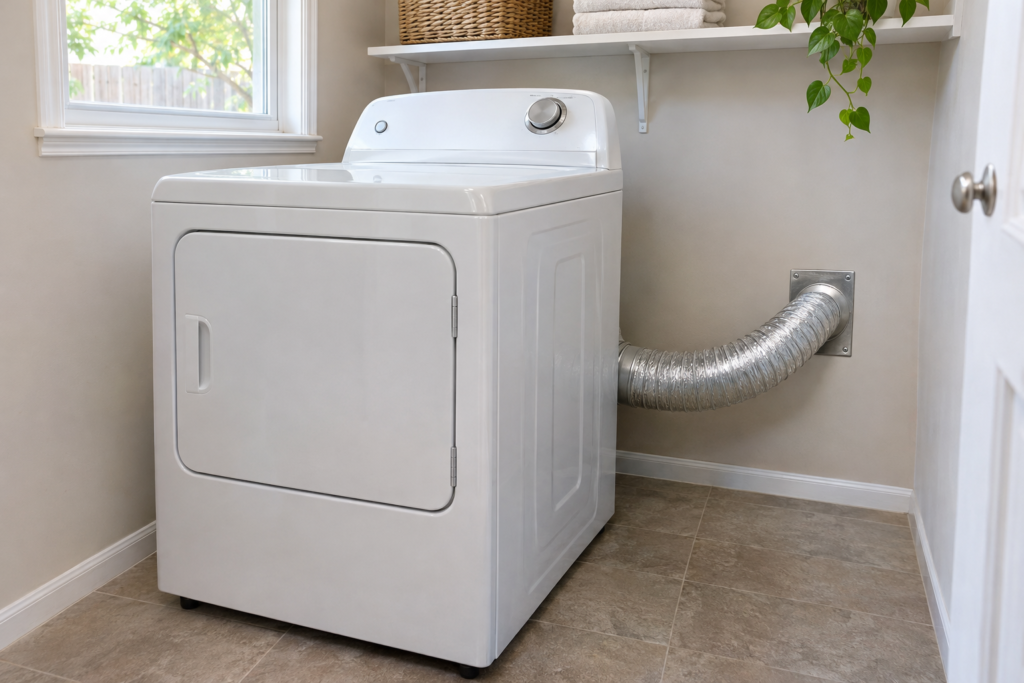
The U.S. Consumer Product Safety Commission tells consumers to clean the lint screen every load, clean the vent and duct periodically, check outside that air is actually blowing out while the dryer runs, and replace plastic or foil accordion-style duct with rigid or semi-rigid metal duct, because the flexible kind traps lint and kinks more easily (CPSC Publication 5022).
The Department of Energy’s Building America Solution Center summarizes the International Residential Code rules (IRC M1502): smooth 4-inch metal duct, generally no longer than 35 feet including the equivalent length of bends (or the manufacturer’s limit), a visible transition hose no longer than 8 feet, no screws poking into the duct, no screen on the outside hood, and a damper on the termination (Building America Solution Center). Your local code may differ, but those numbers are a good yardstick for what “normal” looks like.
The misconception: “The tenant does laundry, so the dryer is the tenant’s problem”
That is only half true. A tenant can and should clean the lint screen and keep the laundry area clear. But the duct inside your walls is part of your building, and a crushed foil hose or a 40-foot run with four elbows is a construction problem, not a housekeeping one.
Interpretation, not fact: In most states, a landlord’s repair duty covers conditions that affect health and safety once the landlord is notified. Texas, for example, requires a landlord to make a diligent effort to repair a condition that materially affects the physical health or safety of an ordinary tenant after notice (Tex. Prop. Code 92.052). A clogged or improperly built vent can fall into that category. Your lease, local code and whether you or the tenant supplied the dryer all matter, so check your state’s rules rather than assuming.
What it costs
Online cost guides commonly put a professional dryer-vent cleaning at roughly $100 to $200, with longer or roof-exit vents costing more (Fixr cost guide). Illustrative, not a quote. A few metal transition hoses and clamps cost far less. Compare that with a fire claim, your deductible, a vacancy during repairs, and possible liability, and this is one of the easier items in your repair budget.
A 7-step remote dryer-vent plan
- Find out what is there. Ask the tenant (or your property manager) for three photos: behind the dryer, the transition hose, and the outside vent hood. Also confirm whether the dryer is gas or electric and who owns it.
- Look for the red flags. White plastic or thin foil accordion hose, a crushed hose behind the machine, a hood with a screen, a flap stuck shut, or lint visible outside.
- Ask two quick questions. Do clothes take more than one normal cycle to dry? Does the laundry room get unusually hot or humid? CPSC lists longer drying times as a warning sign of a blocked screen or duct.
- Book a cleaning and inspection. Have a vent-cleaning company or a vetted handyman clean the full run and send before-and-after photos plus the duct length and number of bends. Use the same contractor vetting steps you use for any other trade.
- Fix what is wrong. Replace plastic or foil hose with UL-listed semi-rigid metal, and ask about any run that seems long. For a gas dryer, make sure the vent goes outdoors and that a working CO alarm is in place. Our smoke and CO alarm check covers that.
- Put it in writing. Add a plain lease or move-in note: the tenant cleans the lint screen every load and reports slow drying; you handle the duct. Text a short reminder before winter.
- Put it on the calendar. Add a vent check to your turnover make-ready list and your winter checklist. Many owners do it once a year; heavy-use homes may need it more often.
The bottom line
You cannot watch the laundry room from another state, but you can make sure the duct is metal, short and clear, and that your tenant knows what to look for. For most small landlords, that is a one-hour phone call, a few photos and one service visit a year.
This article is for general educational purposes only and is not legal, tax, insurance, financial or investment advice. Rules vary by state and city; check current local code and talk with a qualified professional about your property. Cost figures are illustrative. The featured image was generated with AI and does not show a real property.