The 14-Day Turnover: A Remote Landlord’s Make-Ready Plan for Getting a Vacant Rental Back on the Market

Every day a rental sits empty costs you money you never get back. On a house that rents for $1,800 a month, that is roughly $59 a day before you count the mortgage, utilities and lawn care you are still paying. When you live in another state, the danger is not one big mistake. It is a string of small delays: the cleaner who can’t come until Thursday, the painter waiting on the cleaner, the listing waiting on photos.
This is a 14-day make-ready plan built for a 1-5 door owner who can’t drive over and check. It assumes a normal turnover (no major damage). Adjust the days to your market and your crew.
What the numbers say
The U.S. rental vacancy rate was 7.3% in the second quarter of 2026, according to the Census Bureau’s Housing Vacancy Survey. Census says that is not statistically different from a year earlier (7.0%). It is a national figure and your street can be very different, but renters in many markets have choices. A unit that shows well and is listed fast has an edge.
Interpretation, not fact: for a single-family rental, a week of avoidable delay often costs more than the upgrades owners argue about. On our $1,800 example, seven extra empty days is about $415, which pays for a lot of paint.
The common mistake: treating turnover as “just cleaning”
Several legal duties reset each time a new tenant moves in, and remote owners miss them because nobody is standing in the doorway to remind them. Three examples:
- Locks. In Texas, a landlord must rekey key, card or combination locks at the landlord’s expense no later than the seventh day after each tenant turnover date (Tex. Prop. Code 92.156). Texas also lists the security devices a dwelling must have, such as keyed dead bolts or doorknob locks, keyless bolting devices and door viewers on exterior doors (92.153).
- Smoke alarms. Texas requires the landlord to confirm smoke alarms work at the beginning of the tenant’s possession (92.258), with at least one in each bedroom (92.255). Florida requires working smoke detection devices at the start of a single-family or duplex tenancy unless otherwise agreed in writing (Fla. Stat. 83.51(2)(b)). The U.S. Fire Administration says smoke alarms should be replaced 10 years from the manufacture date (USFA).
- Lead paint paperwork. For most housing built before 1978, federal rules require you to give a new tenant the EPA lead pamphlet and disclose any known lead-based paint before they are obligated under the lease, and to keep the signed disclosure for at least 3 years (40 CFR 745.107, 745.113). A renewal with the same tenant can be exempt if nothing new has come to light (745.101(d)), but a new tenant is a new disclosure. EPA’s disclosure page has the forms.
Your state and city may add more (carbon monoxide alarms, registration, inspections). Check your local rules or ask your property manager which items reset at turnover.
The 14-day make-ready plan
- 30 days before move-out: book the crew. As soon as you get notice, schedule the cleaner, painter (if needed), locksmith and carpet cleaner with tentative dates. Ask the tenant for a short video walk-through or a pre-move-out visit by your manager so you know what you are walking into. Our guide to vetting a handyman you’ve never met covers who to trust with a key.
- Day 0 (move-out): get eyes and a video. Your manager or handyman films every room, opens every appliance, runs every faucet and photographs the smoke alarm dates. This same video supports your deposit decision, so follow the steps in our move-out inspection and deposit guide.
- Day 1: write one punch list with prices. Every item, who does it, the cost and the date. Set a dollar limit your handyman can spend without calling you. Anything over it, they send a photo and a quote.
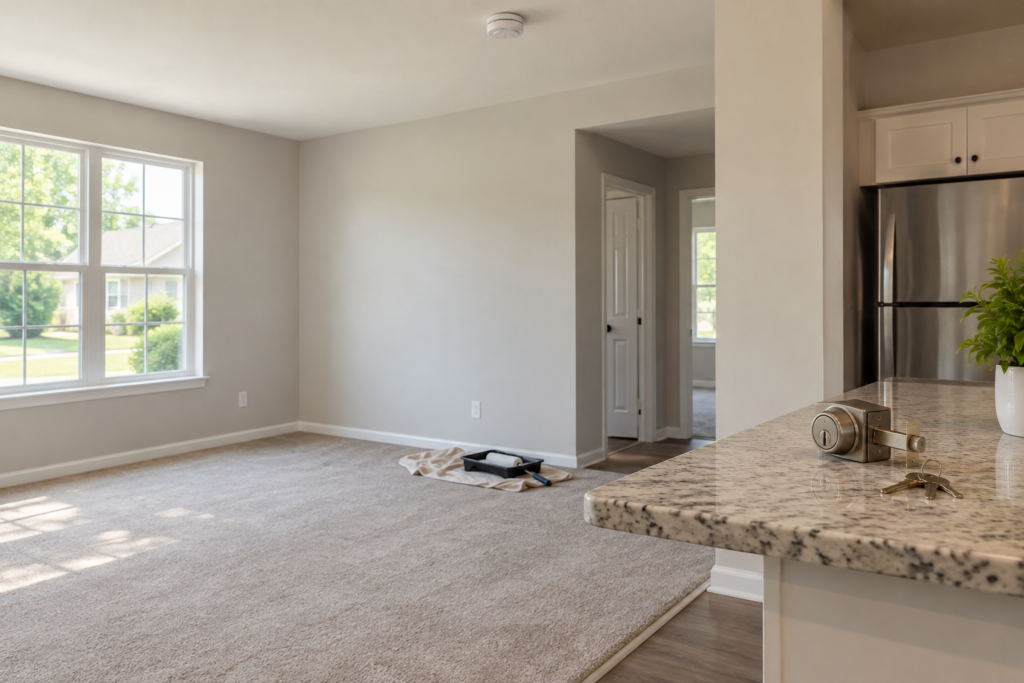
- Day 1-2: rekey and secure. Rekey or swap locks right away (in Texas, the 7-day clock is the law, not a suggestion). A keypad deadbolt saves you a locksmith trip on the next turnover. Collect old keys, garage remotes and mailbox keys.
- Day 2-6: repairs, then paint, then clean. Order matters: dirty work first, cleaning last. Swap any smoke alarm older than 10 years, change the HVAC filter, and replace dead bulbs. Pull money for bigger items from your repair reserve rather than delaying.
- Day 5-7: price it and take photos. Recheck comps with the method in how to set the rent. Photograph the finished rooms in daylight. If the work is not done, wait for real photos; listing with old photos invites angry showings.
- Day 7-14: list, show and screen. Use one written screening standard for every applicant, as in our remote tenant screening system. Before move-in: test every smoke alarm, sign the lead disclosure if the home is pre-1978, record a fresh move-in video, and hand over new keys.
Sample punch list for one house
Illustrative, not a quote. Prices vary widely by market:
- Deep clean: $250-$450
- Rekey 2 exterior doors: $100-$200
- Touch-up paint (walls with scuffs, not the whole house): $300-$800
- Carpet clean: $150-$300
- 2 new 10-year smoke alarms, HVAC filter, bulbs: $80-$150
Total: roughly $880-$1,900. Compare that with the $59-a-day empty cost in our example. Two weeks of avoidable vacancy is about $830 on its own.
What to ask your property manager
- What is your average days from move-out to new lease on houses like mine?
- Who rekeys, and do you send proof of the date?
- Do you test smoke alarms and record their dates at every move-in?
- Who handles the lead disclosure for pre-1978 homes, and where is the signed copy kept?
- Can I see the punch list with prices before work starts?
For the bigger picture on running a rental from afar, see how to manage out-of-state real estate by yourself.
This article is for general education only and is not legal, tax, financial or investment advice. Laws vary by state and city and change over time; check current rules or ask a qualified professional before acting. Cost figures are illustrative examples, not quotes. The featured image is an AI-generated illustration and does not show a specific property.