Is Your Rental’s Water Heater Over 10 Years Old? A 7-Step Remote Check for Out-of-State Landlords

The water heater is the appliance most landlords forget until a tenant texts “no hot water” or, worse, “there’s water all over the basement.” If you own a rental in another state, you probably don’t know how old the tank is, where the shut-off valve sits, or whether anything catches a leak. Here is what the data says about how water heaters fail, what you owe the tenant, what a typical landlord policy pays for, and a seven-step check you can run from home this week.
How water heaters actually fail
The Air-Conditioning, Heating, and Refrigeration Institute says most water heaters have an expected service life of 10 to 13 years. It suggests checking the pressure relief valve and flushing sediment from storage tanks every six months, especially with hard water. Always follow the maker’s manual, though.
The way they fail matters more than when. An insurance-industry review of 700 water-heater claims by the Insurance Institute for Business & Home Safety found that 69% came from tanks slowly leaking or suddenly bursting, mostly from rust and corrosion. Age at failure ran from 1 to 30 years, with an average of 10.7. That study is older, but it’s still the one the industry quotes most.
Interpretation, not fact: a tank past 10 years isn’t guaranteed to fail. But at that age the question is usually “planned replacement on a weekday” or “emergency replacement plus water cleanup on a holiday weekend.” When you live hundreds of miles away, the planned version is almost always cheaper.
What you owe the tenant
- Texas. Prop. Code 92.052 specifically names failing to keep “a device to supply hot water of a minimum temperature of 120 degrees Fahrenheit” in good working order. Once a tenant who is current on rent gives notice, you must make a diligent effort to fix it.
- Florida. Fla. Stat. 83.51(2)(a) lists “running water, and hot water” among the landlord’s duties for units other than a single-family home or duplex, unless agreed otherwise in writing. Single-family homes and duplexes still fall under local housing codes in 83.51(1).
- California. Civil Code 1941.1 treats a unit as untenantable if it substantially lacks a water supply “capable of producing hot and cold running water.” Separately, Health and Safety Code 19211 requires every residential water heater to be braced, anchored or strapped against earthquakes. A seller has to certify that in writing.
Temperature cuts both ways. The Consumer Product Safety Commission urges users to set water heaters to 120°F to prevent scalds, especially for young children and older adults. In Texas, 120°F is also the legal minimum. So 120°F is the number to ask your plumber to set and check with a thermometer at the tap.
The common mistake: “insurance will buy me a new tank”
It usually won’t. The standard ISO dwelling form many landlord policies use (DP 00 03) covers “accidental discharge or overflow of water” from a household appliance. That means the soaked drywall and flooring can be covered. But the same form says it does not cover loss “to the system or appliance from which this water or steam escaped.” It also excludes wear and tear, corrosion, and “constant or repeated seepage or leakage” over “weeks, months or years.”
Interpretation, not fact: a sudden burst is the type of loss these forms are built to cover. A slow drip that rots the subfloor for months is the type they’re built to exclude. And the tank itself is a capital expense either way. Your own policy and endorsements control, so read them or ask your agent. Our landlord insurance checklist walks through the main sections.
What replacement costs
National cost guides such as HomeGuide put a 50-gallon tank replacement at roughly $700–$1,800 installed for electric and $1,000–$3,100+ for gas. Venting changes, permits, expansion tanks and after-hours calls add more. Those figures are illustrative, not a quote. Put the expected replacement in your capex reserve before the tank fails.
The 7-step remote water heater check
- Get a photo of the rating plate. Ask the tenant or your handyman for a clear picture of the label, plus one of the whole tank and the floor around it. The plate shows the fuel type, the capacity and a serial number. On most brands, the serial number encodes the manufacture date. Look up how your brand codes it, or ask the plumber.
- Write down the age and set a replacement year. At 8+ years, get a quote now. Past 10, plan to replace it on your schedule rather than the tank’s.
- Look for early warning signs. Rust at the fittings or the bottom of the tank, water in the pan, a dripping relief-valve pipe, popping noises (sediment) or rusty hot water all justify a plumber visit.
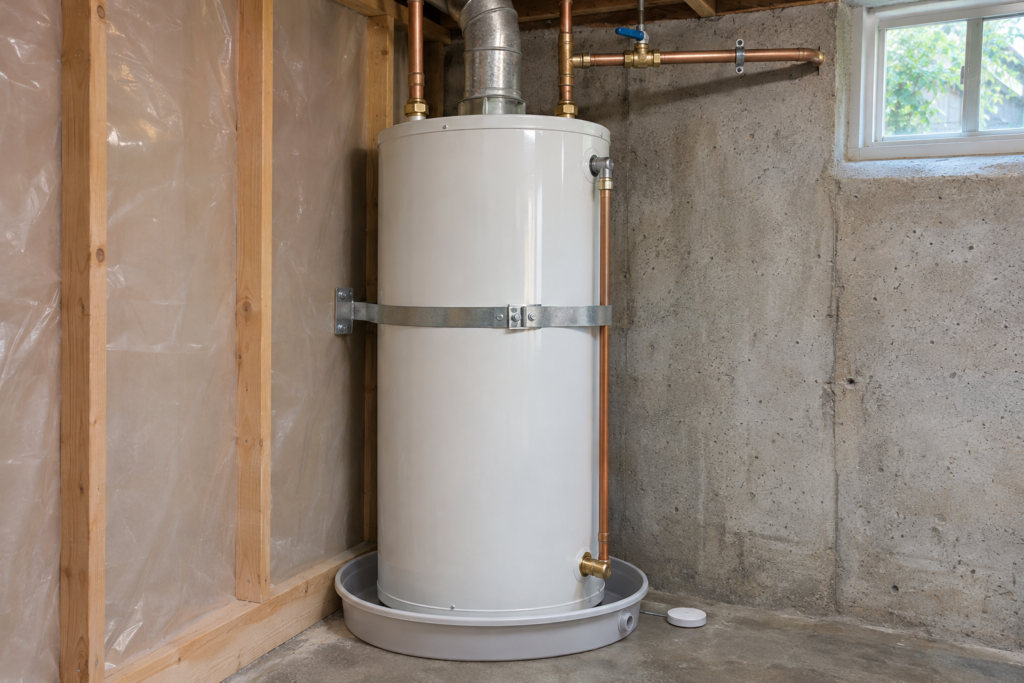
- Add a drain pan and a leak sensor. A pan only helps if it drains somewhere. A Wi-Fi water sensor (or an automatic shut-off valve) is how you learn about a leak before the tenant does.
- Label the shut-offs. Tag the cold-water valve on the tank, the gas valve or breaker, and the main water shut-off. Then put their photos in your 2 a.m. repair playbook.
- Book maintenance with a vetted plumber. Ask for a relief-valve test, a flush if the manual calls for one, a 120°F setting check, and (in California) a strapping check. Use the same vetting steps you use for any contractor, including license and insurance.
- Pre-approve the replacement. Tell your manager or plumber in writing what model class you’ll accept and your dollar limit. That way a dead tank on a Friday gets replaced the same day instead of waiting on a phone call.
Fold the photo request into your next mid-lease inspection, and give tenants entry notice as your state requires.
This article is general educational information for rental property owners. It is not legal, tax, insurance, or financial advice. Laws, codes, and policy wording differ by state, city, and insurer, so confirm details with a licensed professional before acting. Cost figures are illustrative. The featured image is AI-generated and does not show a specific property.