Fridge or Stove Died at Your Rental? What 4 States Require and a 7-Step Repair-or-Replace Plan

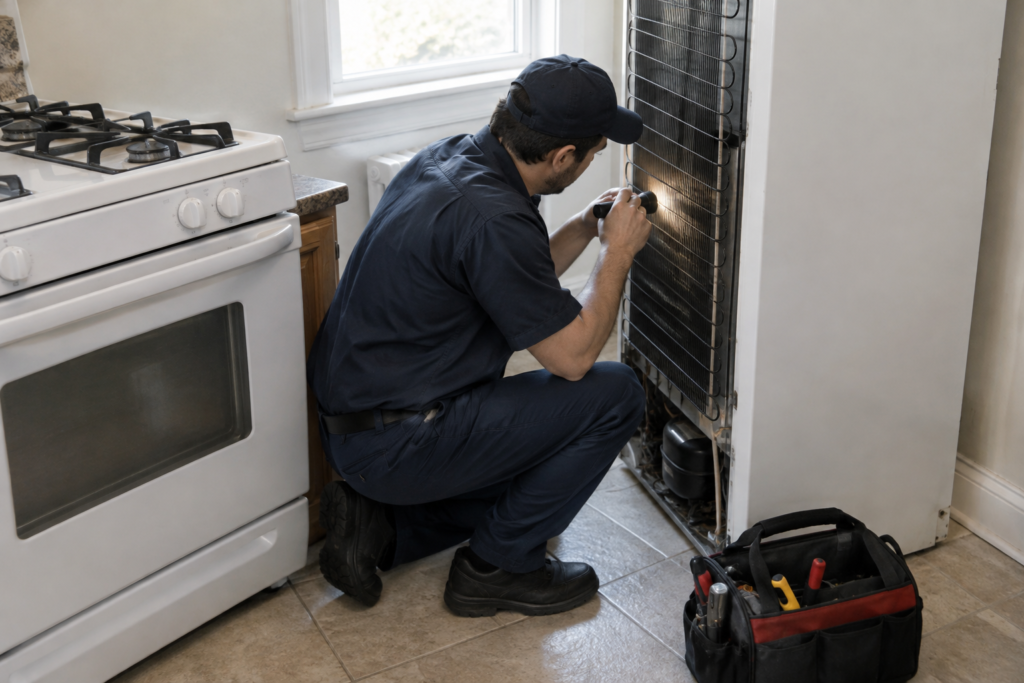
A tenant texts on a Sunday night: the refrigerator is warm and the milk has gone bad. You’re 1,500 miles away. Whose fridge is it, and how fast do you have to act? And with Black Friday appliance sales coming next week, should you repair the old unit or replace it? Here is a plain-English walkthrough for 1-5 door owners, plus a 7-step plan you can hand to your handyman or property manager.
What the law actually says (facts)
No single national rule covers appliances. In most states the question is: did you supply it?
- California changed the rules this year. Under Civil Code 1941.1(a)(10)-(11), a rental is “untenantable” without a stove kept in good working order and a refrigerator “capable of safely storing food.” This applies to leases entered into, amended, or extended on or after January 1, 2026, so a renewal counts. A stove or fridge under a manufacturer or government recall does not count as working. A tenant may choose to bring their own fridge, but only with specific lease wording, and they can later give 30 days’ written notice requiring you to install one. You can’t make the tenant’s own fridge a condition of renting. Some unit types, including SROs and residential hotels, are exempt.
- Washington, Arizona and Oregon: if you supplied it, you maintain it. RCW 59.18.060(8) requires landlords to keep “facilities and appliances supplied by him or her in reasonably good working order.” A.R.S. 33-1324(A)(4) and ORS 90.320(1)(i) say much the same.
- Texas is about health and safety. Under Property Code 92.052, a landlord must make a diligent effort to repair conditions that materially affect an ordinary tenant’s physical health or safety, after notice. The Texas Attorney General notes that a justice of the peace can order repairs costing up to $10,000. Remedies under 92.0563 include a civil penalty of one month’s rent plus $500.
- Florida’s maintenance statute, 83.51, covers structure, plumbing, codes and certain services, and doesn’t mention appliances. For appliances, the lease and any local housing code are what matter.
The common misconception
“The lease says appliances are provided ‘as-is’, so repairs are on the tenant.” Interpretation, not fact: in states like Washington and Arizona, the duty attaches to appliances you supply, and California now requires a stove and fridge regardless. Texas law (92.0563) separately penalizes landlords who knowingly contract out of the statutory repair duty, with one month’s rent plus $2,000. A dead fridge in July Texas heat can easily become a health problem. The safer operating rule: if it was in the unit at move-in and the tenant didn’t break it, plan on fixing it.
Repair or replace? The numbers
The NAHB/Bank of America life-expectancy study (an older 2007 survey, still a widely used benchmark) gives average lifespans of about 13 years for standard refrigerators, 13 (electric) to 15 (gas) years for ranges, 9 for dishwashers and microwaves, 10 for washers and 13 for dryers. ENERGY STAR says refrigerators over 15 years old can cost about $95 more a year to run. That’s a tenant’s cost if they pay electric, but it shows up in complaints and turnover.
Illustrative, not a quote: a 12-year-old fridge needs a $380 compressor-relay and diagnostic visit. A comparable new top-freezer model costs $700-$900 installed. Many owners use a rough rule of thumb: once a repair passes about half the replacement cost on an appliance near the end of its life, replace it. That’s a judgment call, not a standard. Factor in one more trip charge when the next part fails.
On taxes, IRS Publication 527 lists stoves and refrigerators used in residential rentals as 5-year property under GDS. A repair is generally an expense, while a replacement is usually depreciated (or may fit a de minimis election). Ask your tax preparer which applies to you.
Your 7-step appliance plan
- Build an appliance list today. Ask your tenant or handyman for photos of each appliance’s model/serial plate. Record the brand, model and approximate age; the manufacturer’s site often decodes the serial into a build date. Add the list to the property folder you keep for year-end records.
- Check recalls. Search each model at CPSC Recalls. In California, a recalled stove or fridge doesn’t meet the habitability standard. Everywhere else, it’s still a safety risk you now know about.
- Write appliances into the lease. List exactly which appliances you provide and who handles repairs. Note tenant-caused damage and ask for prompt reporting. In California, use the statutory wording if the tenant brings their own fridge. Do this at your next renewal.
- Set triage rules. A dead fridge, no working stove, or a leaking washer is urgent (target 24-72 hours). A broken dishwasher or microwave is routine. Put this in your 2 a.m. repair playbook. Consider reimbursing a tenant’s spoiled food or a cooler of ice during the wait. It’s cheap goodwill.
- Pre-approve a repair cap. Give your handyman or PM a dollar limit (for example $300) and an age trigger (“call me before repairing anything over 10 years old”). See our guide to vetting a handyman remotely.
- Replace with delivery, install and haul-away. Under EPA’s Clean Air Act Section 608 rules, refrigerant has to be recovered before an old fridge is scrapped. Retailer haul-away or a utility recycling program handles this. Don’t let a helper dump it behind the garage. Match dimensions and fuel type (gas versus electric range) before you order, and get photos after installation.
- Fund it. A unit with four appliances that average 10-13 years means one replacement every two to three years. Budget that in your capex reserve instead of treating it as a surprise. If you’d rather not handle this yourself, it’s a good question to ask when you hire a property manager. More tools are on our resources page.
The bottom line
Appliances are small-dollar items that cause outsized tenant frustration. A model list, a recall check, a lease clause, and a pre-approved repair cap let you handle a dead fridge from another state in one phone call. For more on running a rental from afar, see how to manage out-of-state real estate by yourself.
This article is for general educational purposes only and is not legal, tax, financial or investment advice. Landlord-tenant rules vary by state and city and change over time; check current law or consult a qualified professional for your situation. Cost figures are illustrative examples, not quotes. The featured image is AI-generated and does not depict a real property or person.