Your Out-of-State Rental Is Empty: A 7-Step Plan to Stop Listing Scammers and Squatters Before They Find It


Between tenants, your rental is just a quiet house with listing photos all over the internet. For an owner who lives 1,000 miles away, that is the risky stretch: scammers can copy your ad and “rent” the place to strangers, and an empty house is easier for someone to move into without asking. Here is a practical plan for the weeks it sits empty.
What the official sources say
- Listing scams are common and mostly start on social media. Since 2020, people have reported nearly 65,000 rental scams to the FTC, with about $65 million in losses. In the 12 months ending June 2025, about half of people who reported one said it started with a fake ad on Facebook, and another 16% said Craigslist (FTC Data Spotlight, Dec. 2025).
- The usual method is copying a real listing. Scammers copy the photos and description of a real rental, swap in their own contact details, and repost it elsewhere. They typically avoid in-person showings and push for an application fee or deposit up front (FTC: Rental Listing Scams).
- Your insurance may cover less once the house sits empty. The standard ISO DP-3 dwelling form excludes vandalism and malicious mischief, and certain glass breakage, if the dwelling has been vacant for more than 60 consecutive days before the loss (ISO DP 00 03 07 14). Your own policy may use different wording, so check it.
- Several states added faster remedies for unauthorized occupants:
- Florida lets an owner or authorized agent file a sworn complaint with the county sheriff to remove people who were never tenants. The property must not have been open to the public, the owner must have told them to leave, and no related lawsuit can be pending. A person wrongfully removed can sue for damages, including triple the fair market rent plus attorney fees (Fla. Stat. 82.036).
- Georgia made “unlawful squatting” a misdemeanor. A person who gets a citation has three business days to produce a lease or proof of rent payments (HB 1017, O.C.G.A. 16-7-21.1).
- Texas allows a landlord who files a sworn forcible-entry petition to ask for summary disposition without a trial, for suits filed on or after January 1, 2026 (SB 38 bill analysis).
- New York added to RPAPL 711 that a squatter is not a tenant (RPAPL 711).
The misconception: “If squatters show up, I’ll just call the police”
Interpretation, not fact: The faster state procedures above share one condition: you have to prove the occupants never had permission. Florida’s process does not apply to current or former tenants, and the complaint is signed under penalty of perjury. Georgia’s process turns on whether the occupant can produce a lease or proof of rent. A scammer who “rented” your house to a family has given those people a lease and payment receipts. They are victims too, and a fake lease can push the case out of a quick police matter and into the slower court process. The cheapest fix is to make the fake listing fail before anyone pays for it.
The 7-step vacant-rental plan
- Search for your own address the day the listing goes live, then twice a week. Search the street address in quotes, and check Facebook Marketplace and Craigslist for your listing photos. FTC’s own tip for renters is to look for the same address listed under a different name or price. Do the same check from the owner’s side.
- Put one verification line in your real ad. For example: “Listed only by [your name/company]. We never ask for payment before a tour or a signed lease.” Name the single phone number or website applicants should use. This gives would-be victims a way to spot the fake.
- Report copies right away. Use the platform’s report button and file at ReportFraud.ftc.gov. Save screenshots with dates. If someone later turns up holding a “lease,” that file is your evidence that you never authorized it.
- Control the keys and codes. Rekey or change smart-lock codes at turnover (see the 14-day turnover plan). Use one-time showing codes that expire. Avoid a lockbox code that stays the same for weeks.
- Make the house look occupied, and check it in person every week. Keep utilities on, set lights on timers, have the mail picked up and the yard cut. Pay a vetted local handyman or your manager to walk the house weekly and send dated photos of every door, the windows, and the thermostat. Illustrative cost, not a quote: $40-$75 per visit.
- Mark day 45 and day 60 on your calendar. Before day 60, call your agent. Ask what your landlord policy says about vacancy, and whether you need a vacancy endorsement or a separate vacant-dwelling policy.
- Have a written “unknown occupant” plan before you need one. Keep a short file ready: your deed or tax record, a copy of your ID, a letter authorizing your local manager or agent to act for you, and the non-emergency number for the local sheriff. If someone is inside: do not change the locks, cut utilities or confront them yourself. Call law enforcement, give them your documents, and talk to a local landlord-tenant attorney about which process applies.
Questions to ask your property manager
- Who checks for copies of the listing, and how often?
- Are showing codes one-time or reused? Who can see the access log?
- Will you send weekly dated photos while the house is empty?
- What would you do in the first hour if you found someone living there?
The best protection is a short vacancy. Price the unit correctly from day one with the 6-step rent pricing method, and see the broader guide to managing out-of-state property yourself.
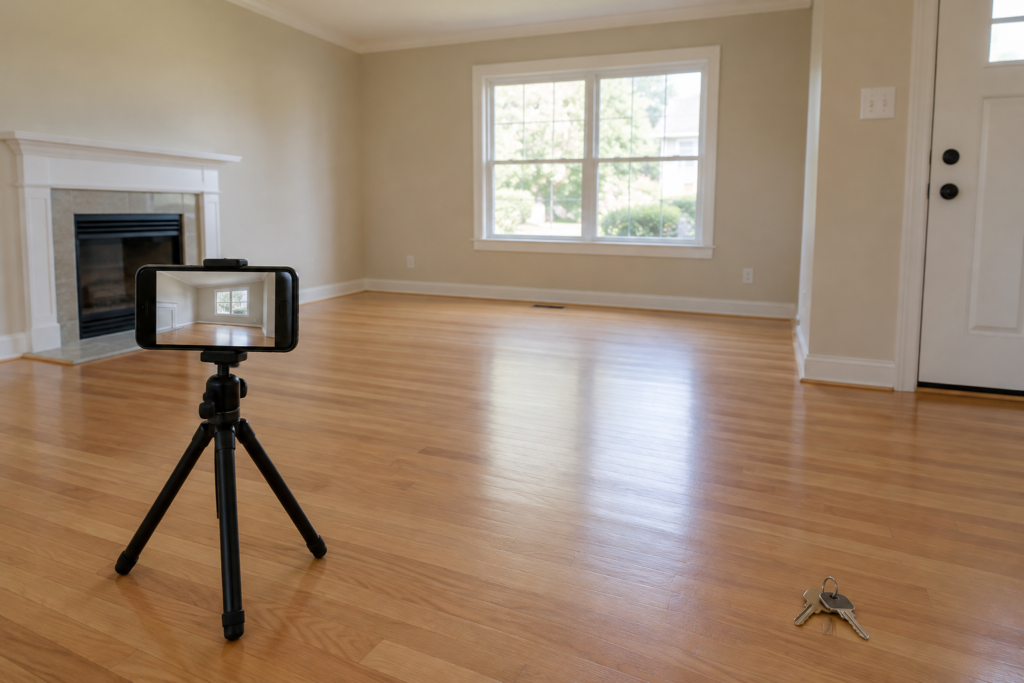
This article is for general educational purposes only and is not legal, tax, insurance, financial or investment advice. Removal procedures differ by state and county and change over time. Confirm your situation with a licensed local attorney, your insurance agent and local law enforcement before acting. Cost figures are illustrative examples, not quotes. The featured image is an AI-generated illustration.