Three HUD Inspection Deadlines, One Rental: Why Your HOME Unit Now Has Until April 14, 2027


If you rent a unit that touches any HUD money — a Housing Choice Voucher tenant, a HOME-funded rehab, a Housing Trust Fund project, or a rapid-rehousing tenant paid through a Continuum of Care grant — you have probably been told that HUD’s new inspection standard, NSPIRE, “took effect in 2023.” That is true of the rule. It is not true of the deadline that applies to you. Right now there are three different compliance dates in force, and which one governs your unit depends entirely on which program pays the rent.
For an absentee owner, that distinction is the difference between a surprise re-inspection this fall and a full extra year to get the smoke alarms, GFCI outlets and guardrails right.
The three dates, from HUD’s own notices
Fact. HUD has published the deadlines separately:
- Housing Choice Voucher, Project-Based Voucher and Section 8 Moderate Rehabilitation: January 31, 2027. HUD’s third extension notice (90 FR 46911, September 30, 2025) extends voucher-program compliance through January 31, 2027, so your PHA must inspect under NSPIRE by February 1, 2027 — see our piece on that switch.
- Emergency Solutions Grants and Continuum of Care: October 1, 2026. The companion notice (90 FR 46912) extended the Community Planning and Development programs to October 1, 2026, and for ESG and CoC that date still stands — about three weeks away.
- HOME Investment Partnerships and Housing Trust Fund: April 14, 2027. HUD’s implementation notice for HOME and HTF (91 FR 19145, published April 14, 2026) says the compliance date is “further extended to 365 days from the publication of this notice.” HUD’s reasoning: jurisdictions need at least 12 months to rewrite property standards and retrain inspectors.
So the single most common statement in landlord forums — “NSPIRE is live, HQS is gone” — is wrong for most assisted units today. The old Housing Quality Standards and Uniform Physical Condition Standards are still the operative test in HOME and HTF until April 2027, and in voucher units until February 2027.
The grandfather clause most owners miss
Fact. The HOME/HTF notice states that “for all activities with written agreements executed prior to the compliance date, participating jurisdictions and grantees may continue to comply with the previous standards as defined in the HOME and HTF regulations at 24 CFR parts 92 and 93.” It adds that NSPIRE applies only to projects with new HOME or HTF commitments made on or after the effective date, and that “new regulatory requirements cannot be imposed on project owners unless permitted by the project written agreement.”
Interpretation, not fact: if your HOME agreement predates NSPIRE and does not reference it, a jurisdiction likely cannot impose the new checklist mid-affordability-period; it standardizes going forward, usually at the next agreement or new commitment. Read your written agreement before accepting a claim that a new standard applies to you.
What actually changes inside the unit
The HOME/HTF notice spells out the “affirmative requirements” — pass/fail items in the Inside, Outside and Unit areas of 24 CFR 5.703. The ones that most often fail in older single-family rentals:
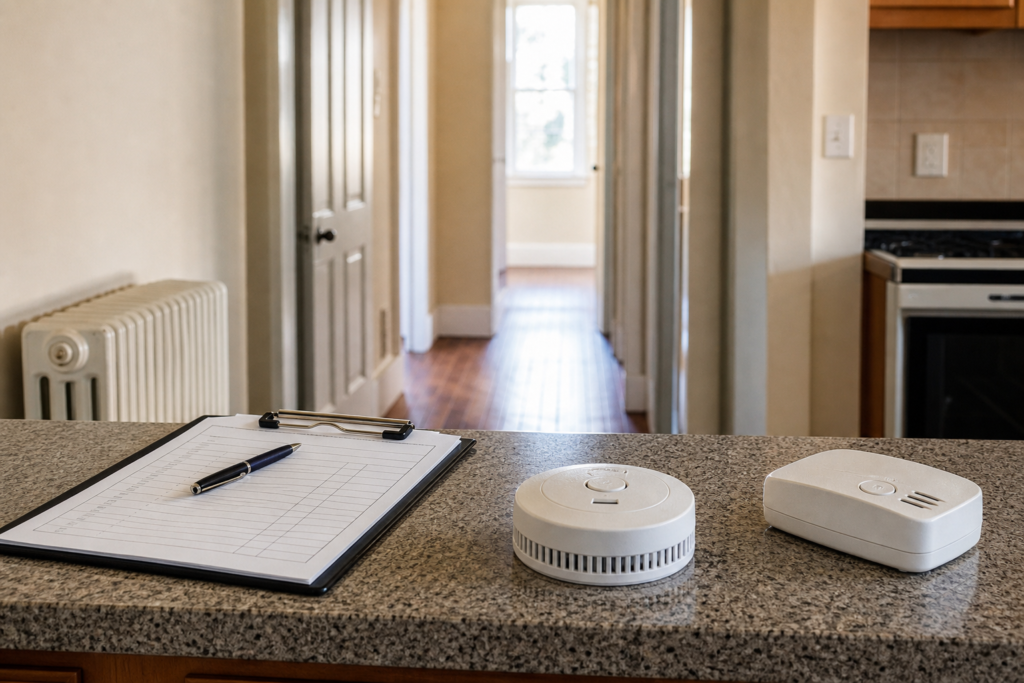
- Smoke alarms on every level, inside each bedroom, and within 21 feet of any bedroom door measured along a path of travel — plus one on the living-area side of a door separating an outside-bedroom alarm from the living area.
- GFCI protection on any outlet within six feet of a water source, inside and outside.
- Guardrails wherever a walking surface drops 30 inches or more.
- Permanently mounted light fixtures in the kitchen and every bathroom; two working outlets (or one outlet plus a permanent light) in every habitable room.
- A permanently installed heating source in every climate zone except Hawaii, Puerto Rico, Guam, the U.S. Virgin Islands, American Samoa and the Northern Mariana Islands; no unvented gas, oil or kerosene space heaters anywhere.
One genuine gap: carbon monoxide requirements were added to NSPIRE under statutes that do not cover HOME or HTF, so HUD is deferring CO rules to future rulemaking while still requiring state and local CO compliance and “strongly” encouraging CO detection in property standards. Treat CO alarms as required anyway — the cost is trivial next to the liability.
Inspection frequency and the small-project carve-outs
Fact, from the same notice: units occupied by HOME tenant-based rental assistance tenants get an annual on-site inspection. HOME- and HTF-assisted rental projects get an inspection within the first 12 months after completion and then at least once every three years. Owners must also self-certify annually that each building and assisted unit is suitable for occupancy — and that certification does not replace the on-site inspection.
Two rules matter specifically to small portfolios. First, sampling: for projects with one to four assisted units, 100% of assisted units are inspected — there is no sampling relief for a duplex or fourplex. Second, a life-threatening deficiency normally forces a property onto a more frequent inspection schedule, but the 2025 HOME final rule lets a jurisdiction choose not to for one-to-four-unit projects if it says so in its inspection procedures. Life-threatening deficiencies must be corrected immediately; non-life-threatening ones get a follow-up on-site inspection within 12 months, though a jurisdiction may accept third-party proof — a paid invoice for a work order, for example — for a defined list of non-hazardous items.
Your checklist before October 1
- Identify the funding source for each assisted unit — voucher, HOME, HTF, ESG or CoC. That single answer sets your deadline.
- If any tenant is paid through an ESG or CoC grant, act now. October 1, 2026 is the live date for those programs.
- Pull your HOME/HTF written agreement and check the execution date and whether it lets the jurisdiction impose new standards.
- Ask your participating jurisdiction, in writing, when it will adopt NSPIRE-based standards and to send you its written property standards and inspection procedures.
- Walk the affirmative list with your property manager — alarms, GFCIs, guardrails, fixtures, heat. These are cheap fixes that fail inspections. If you manage remotely, see how to hire a property management company and managing an out-of-state rental yourself.
- Budget for the annual owner certification and keep repair invoices — they can substitute for a re-inspection on non-hazardous items. Our investment calculators and professionals directory can help you price and staff the work.
This article is educational information for property owners, not legal, tax, financial or investment advice. Program requirements are set by HUD and administered locally, and your participating jurisdiction or public housing agency may adopt stricter standards or different timelines. Verify your own situation against the cited Federal Register notices, your written agreement, and your jurisdiction’s published property standards, and consult a qualified professional before acting.
Related: Your PHA May Be Playing by Different Section 8 Rules: HUD Just Revised the Moving to Work Rulebook