Your Section 8 Inspection Rules Change by February 1, 2027 — and Your PHA Picks the Date This Month

If you rent an out-of-state house to a Housing Choice Voucher (Section 8) tenant, the rulebook your unit is inspected against is changing — and there is a date on the calendar this month that decides when it changes for you. By September 30, 2026, HUD has asked every public housing agency (PHA) to email in the date it will switch its inspections from the old Housing Quality Standards (HQS) to the new NSPIRE standards. The outside limit for that switch is February 1, 2027.
That is the whole story in two sentences, but the details are where absentee owners get burned — because the inspection standard, the repair clock, and the consequences for missing it are three different things, and only one of them is actually being delayed.
The facts, with sources
NSPIRE stands for National Standards for the Physical Inspection of Real Estate. It is HUD’s attempt to use one physical-condition standard across public housing, multifamily, and the voucher programs. For voucher programs, NSPIRE technically became effective October 1, 2023, but HUD has extended the compliance date three times. The most recent extension, published at 90 FR 46911 (September 30, 2025), runs the old standard through January 31, 2027 for the HCV, Project-Based Voucher, and Section 8 Moderate Rehabilitation programs.
The operating instructions live in HUD Notice PIH 2026-18, issued July 15, 2026, which supersedes Notices PIH 2023-28 and 2024-26. Four things in it matter to a landlord:
- Your PHA picks the date, not you. A PHA may keep using “HQS as previously defined” until February 1, 2027, or switch earlier. PHAs are told to email HUD their implementation (or planned implementation) date by September 30, 2026. So the standard your unit is inspected against this fall depends entirely on which agency administers your tenant’s voucher.
- PHAs must tell you before it applies to you. The notice states that PHAs implementing NSPIRE must notify all participating owners and families of the change, what the standards are, and when they take effect for their inspections.
- Some parts were never delayed. The extension covers a specific list of provisions (the HQS definitions at 24 CFR 982.4 and 983.3, 24 CFR 982.401, 983.101(a)-(b), and certain special-housing-type items). Everything else in the NSPIRE final rule already applies — including the move to periodic inspections at least every two years for HCV units (three years for small rural PHAs).
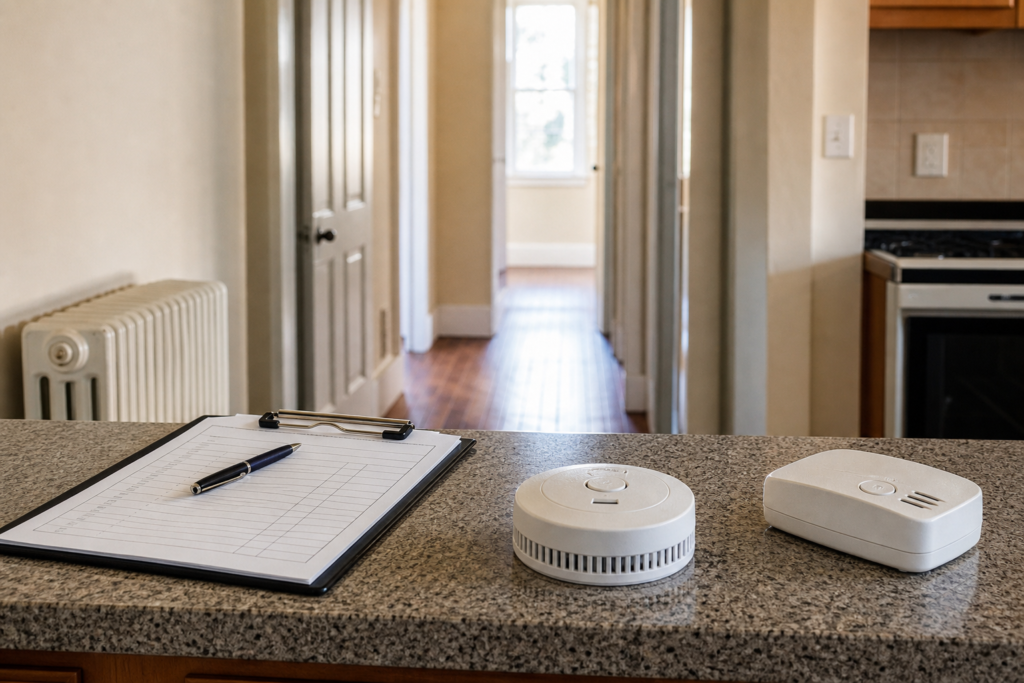
- Smoke and CO alarm rules apply either way. Carbon monoxide alarms have been an inspectable item since December 27, 2022 (Notice PIH 2022-01). And since December 29, 2024, under the Consolidated Appropriations Act, 2023, smoke alarms must be hardwired or sealed 10-year battery units. HUD points out in the notice that the old checklists (forms HUD-52580 and 52580-A) do not include these requirements — so “the inspector used the old form” is not a defense.
The repair clock is the part that actually hurts
Under NSPIRE, deficiencies are sorted by severity. A condition on HUD’s life-threatening (LT) list (published at 88 FR 40832, Table 65) must be corrected within 24 hours of the owner being notified of the results. Severe and moderate non-life-threatening deficiencies get 30 days, or a PHA-approved extension consistent with its policy. “Low” deficiencies are noted but do not fail the unit.
If a deficiency is not corrected in time, the PHA “must initiate Housing Assistance Payment (HAP) contract enforcement,” which can include withholding or abating your assistance payments, terminating the HAP contract, or relocating the family. Under HOTMA, certain remedies became mandatory for contracts entered or extended after June 6, 2024 — meaning the PHA has less discretion to be lenient than it once did.
A 24-hour repair window is a very different thing when you are 1,200 miles away. That is a logistics problem, not a legal one, and it is solvable in advance.
What is genuinely better under NSPIRE
NSPIRE is not simply stricter. Two changes cut in the owner’s favor. The “Site and Neighborhood” requirement is removed from unit inspections (it still applies to PBV site selection under 24 CFR 983.55), and HUD says the standards remove “subjective opinions about general health and safety, housekeeping, and cosmetics/aesthetics.” The focus moves to the condition of the dwelling unit and resident health and safety. In practice, fewer fails over the tenant’s clutter and the neighbor’s yard; more fails over electrical, heat, water, alarms, and moisture.
Also worth knowing: 24 CFR 5.707 exempts voucher-program owners from NSPIRE’s self-inspection requirement. Some landlords have heard the opposite. HUD encourages routine owner inspections, but does not mandate an annual self-inspection filing for HCV, PBV, or Mod Rehab units.
The misconception worth correcting
The common version circulating in landlord groups is “HQS is dead, NSPIRE started in 2023.” That is half right and useless in practice. NSPIRE’s effective date was October 1, 2023; the compliance date for voucher programs has been pushed to February 1, 2027, and each PHA transitions on its own date somewhere in between. And there is a transition rule most people miss: under PIH 2026-18, a unit and owner stay subject to the requirements in effect on the date of the inspection until that inspection is fully resolved — even if the PHA switches to NSPIRE mid-process. A failed inspection from before the switch gets re-inspected under the old standard.
Interpretation, not fact: for a remote owner, the biggest practical risk in the next six months is not the standards themselves — it is the possibility of being surprised by a 24-hour LT correction with no local contractor on standby. Two agencies in two states may be on two different standards on the same day, and nothing requires them to align.
A short checklist for absentee owners
- Find out your PHA’s transition date. One email or call to the housing agency administering your tenant’s voucher: “Have you implemented NSPIRE, and if not, what date have you given HUD?”
- Ask how they will notify you of the change and of inspection results. The notification channel matters more than the standard — if their notices go to an address you left three years ago, your 24-hour clock is already running.
- Download the NSPIRE HCV/PBV Inspection Checklist from HUD’s NSPIRE page and walk your unit against it — remotely with your manager if needed. Focus on electrical, heat, hot water, GFCI/outlet condition, guardrails, and alarms.
- Fix the alarms now. Hardwired or sealed 10-year battery smoke alarms, plus CO alarms where required. This is the single most common, cheapest, and most avoidable fail. Our October rental checklist shows how to date-check every alarm from another state.
- Build a 24-hour response bench. An electrician, a plumber, and an HVAC contractor who will take a same-day call, plus written authority for your property manager to spend up to a set dollar amount without asking you first.
- Ask your manager who attends inspections. Someone should be there with the checklist, a phone camera, and the ability to correct trivial items on the spot.
- Confirm reinspection and verification methods. Some PHAs accept photos (Notice PIH 2013-17) or remote video (Notice PIH 2020-31) to verify corrections. If yours does, that turns a 24-hour fix from impossible to routine.
None of this changes the underlying question of whether voucher tenancies fit your strategy. If you are still weighing that, our overviews of whether out-of-state investing suits you and managing a remote rental yourself are the place to start. And if your unit sits in a voucher market, HUD’s FY2027 Fair Market Rents — effective October 1, 2026 — set the payment-standard ceiling you will be negotiating against at the same time.
This article is educational information for property owners, not legal, tax, financial, or investment advice. Inspection requirements vary by public housing agency and by state and local law, and HUD guidance changes. Verify current requirements with the PHA administering your tenant’s voucher and with HUD’s official notices, and consult a qualified professional about your specific situation.