HUD’s FY2027 Fair Market Rents Are Out: 28% of Areas Went Down. What It Means for Your Out-of-State Rental

HUD published its Fiscal Year 2027 Fair Market Rents (FMRs) in the Federal Register today — September 1, 2026 (91 FR 56156, Docket FR–6553–N–03). The new numbers take effect October 1, 2026. If you own a rental in a state you don’t live in, this is one of the few national datasets that lands on your calendar every year with a hard date attached, and it is worth 20 minutes of your attention this week.
The part most owners miss: FMRs are not a forecast of what your tenant will pay. They are HUD’s estimate of the 40th-percentile gross rent (shelter rent plus tenant-paid utilities) for standard-quality units in an area, and they anchor the payment standards housing authorities build for vouchers. They matter directly if you rent to a Housing Choice Voucher household, and indirectly as a free, consistent read on where rent levels in your market are drifting.
What we found in the FY2027 file
We pulled HUD’s own FY2027 county-level FMR spreadsheet and compared it line by line against the revised FY2026 file (4,758 matched county/FMR-area records). For two-bedroom units:
- The median area change is +3.4%, and the population-weighted average change is only +2.0% — meaning the bigger increases are concentrated in smaller, less populated areas.
- 28% of areas are going down, not up. That is more than one in four.
- 119 areas sit at exactly -10%, which is the floor: HUD’s rules at 24 CFR 888.113 prevent an FMR from falling below 90% of the prior year.
- 13% of areas rose more than 10%.
- Non-metro areas moved up slightly more (median +4.0%) than metro areas (median +3.0%).
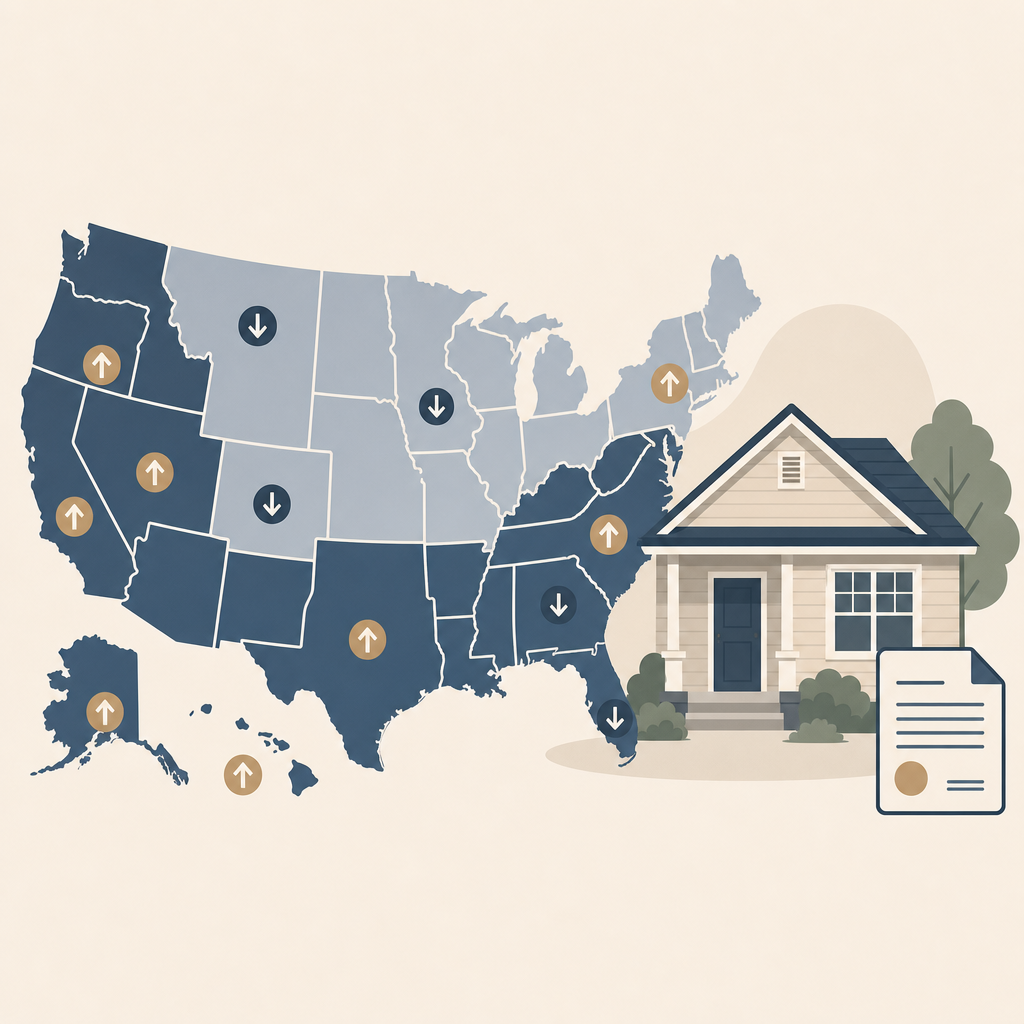
State-level medians run from roughly -8% (New Hampshire, Arizona) to +13% to +16% (Alabama, Vermont, North Dakota). A sample of metros that absentee investors buy in often, two-bedroom FY2026 → FY2027:
- Kansas City, MO-KS: $1,358 → $1,546 (+13.8%)
- Columbus, OH: $1,430 → $1,602 (+12.0%)
- St. Louis, MO-IL: $1,218 → $1,349 (+10.8%)
- Birmingham-Hoover, AL: $1,266 → $1,375 (+8.6%)
- Pittsburgh, PA: $1,299 → $1,389 (+6.9%)
- Indianapolis-Carmel, IN: $1,473 → $1,536 (+4.3%)
- Memphis, TN-MS-AR: $1,274 → $1,301 (+2.1%)
- Cleveland, OH: $1,279 → $1,274 (-0.4%)
- Little Rock, AR: $1,147 → $1,121 (-2.3%)
- Atlanta-Sandy Springs-Roswell, GA: $1,820 → $1,762 (-3.2%)
Interpretation, not fact: the pattern is consistent with rent growth having rotated away from the Sun Belt metros that absorbed huge amounts of new apartment supply and toward Midwest and Plains markets where very little got built. HUD’s numbers are lagged — base rents come from 2020–2024 five-year American Community Survey data, then get pushed forward with private-market and CPI rent inflation factors — so treat them as confirmation of a trend, not as breaking news about today’s leasing conditions.
What an absentee owner should actually do with this
1. Look up your own county, not the national number. FMRs are set by FMR area, and HUD publishes ZIP-code-level Small Area FMRs (SAFMRs) for every metro and non-metro area too. In metros where SAFMRs are mandatory, your specific ZIP code drives the payment standard, not the metro average. Two houses 15 minutes apart can sit in very different SAFMR bands.
2. If you have a voucher tenant, expect the payment-standard conversation in the fall. Housing authorities set payment standards within a range around the FMR and are not obligated to move them the moment FMRs change. A rising FMR does not automatically raise what you get, and a falling FMR does not automatically cut it — existing contracts and PHA policy govern. Ask your PHA directly what their 2027 payment standards will be and when they take effect.
3. Use FMRs as a sanity check on your property manager. If your manager has been telling you $1,150 is the ceiling for a three-bedroom in a market where the FY2027 three-bedroom FMR is $1,900, that gap deserves an explanation — it may be property condition, sub-market, or a stale rent survey. This is exactly the kind of number to bring to a quarterly manager call. Our guides on how to hire a property management company and managing an out-of-state rental yourself cover how to structure that review.
4. Watch the down-markets more carefully than the up-markets. A -3% FMR in a metro where your insurance and taxes are climbing is a margin-compression signal. If you are underwriting a purchase in one of those areas, be skeptical of pro formas built on 3–4% annual rent growth.
5. Note the comment window. HUD accepts public comments and formal reevaluation requests on FY2027 FMRs through October 1, 2026, via regulations.gov under the docket above. Reevaluations are normally driven by housing authorities with local survey data, not individual landlords — but if you operate in an area where the published FMR looks obviously wrong, your PHA is the party to talk to.
Context worth keeping in view
The Census Bureau’s latest Housing Vacancy Survey put the national rental vacancy rate at 7.3% in Q2 2026, statistically unchanged from 7.3% in Q1 2026 and 7.0% a year earlier. A softer-but-stable national rental market with sharply divergent local numbers is exactly the environment in which a national average tells you almost nothing and your specific ZIP code tells you everything. The next vacancy release is October 28, 2026.
Two guardrails worth filing away: the national non-metropolitan rent for FY2027 is $1,014, which feeds the minimum-FMR floor, and a two-bedroom Small Area FMR cannot exceed 150% of its parent area’s two-bedroom FMR.
If you are still deciding whether long-distance ownership fits how you want to spend your time, start with is out-of-state real estate investing for you. And if you are already an absentee owner, pair today’s rent data with the local compliance calendar we covered in out-of-state landlord registration rules — rents and registration deadlines both tend to land on October 1.
Sources
- HUD, Fair Market Rents… Fiscal Year 2027, 91 FR 56156, September 1, 2026 — Federal Register notice (PDF)
- HUD USER, FY2027 FMR data files and documentation (FY27_FMRs.xlsx; FY2026 revised file used for comparison)
- 24 CFR 888.113 — FMR calculation and the limit on annual decreases
- U.S. Census Bureau, Quarterly Residential Vacancies and Homeownership, Q2 2026 (CB26-116)
Educational note: this article is general educational information for rental property owners and is not legal, tax, financial, lending, or investment advice. Fair Market Rents do not determine what any individual landlord may charge, and voucher payment standards are set by local housing authorities. Verify all figures against the primary HUD files for your own county and consult qualified professionals about your specific situation.