Thanksgiving Is the No. 1 Day for Kitchen Fires: A 7-Step Plan for Out-of-State Landlords

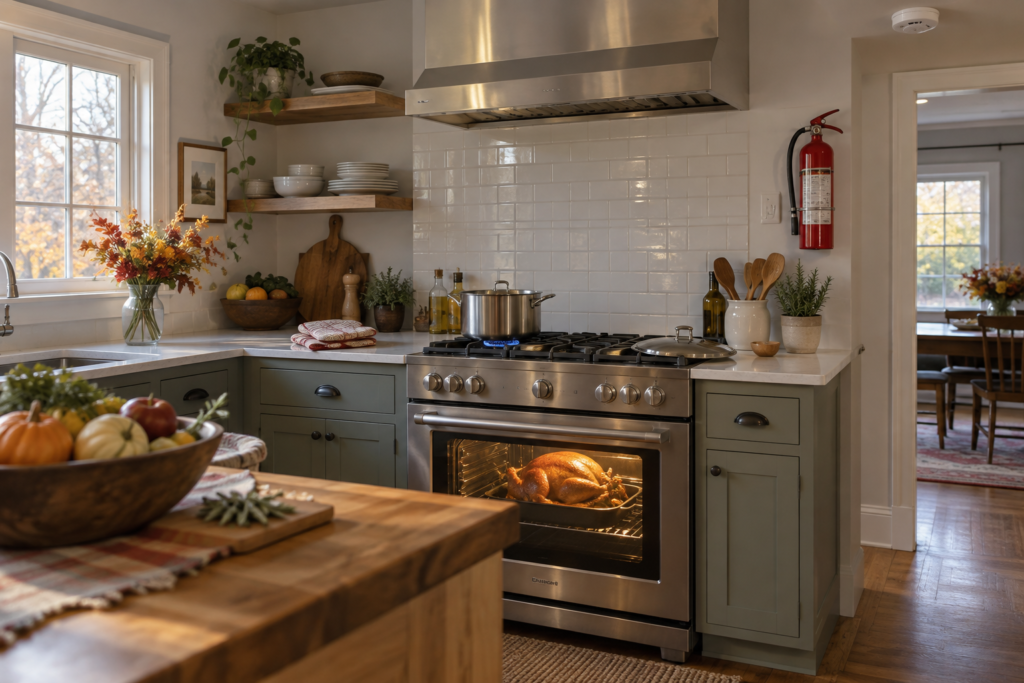
Tomorrow is the busiest day of the year for kitchen fires in the United States. You can’t stand in your out-of-state rental’s kitchen, but 20 minutes today can keep a burned pan from becoming a gutted unit, a displaced tenant and months of lost rent.
What the data says (fact)
- The National Fire Protection Association (NFPA) estimates 1,139 home cooking fires were reported on Thanksgiving Day 2024, 321% above the daily average. Christmas Day and Christmas Eve ranked second and third. Cooking causes about 48% of all reported U.S. home fires, and unattended cooking is the leading contributing factor.
- The U.S. Fire Administration found cooking caused 74% of Thanksgiving Day residential building fires (2017-2019), and 54% of them started between 10 a.m. and 5 p.m., earlier than the usual 5-8 p.m. dinner peak.
- Across the whole year, residential building cooking fires numbered about 160,300 in 2024, with $481.2 million in reported losses (USFA).
The misconception: “If my tenant starts a kitchen fire, that’s their problem”
It usually becomes your problem first. Your dwelling policy covers the structure; it does not cover the tenant’s belongings. As the Insurance Information Institute puts it, your coverage is “only on the structure itself and your financial interest in it.” So you file the claim, coordinate repairs from out of state, and lose rent while the kitchen is rebuilt unless you carry loss-of-rent coverage.
State law can also cut the rent while you wait:
- Texas: under Prop. Code 92.054, if a fire leaves the home “totally unusable” and the tenant (or their family or guests) didn’t cause it, either side can end the lease with written notice before repairs are done; the tenant gets a pro rata rent refund. If it’s only partially unusable, a rent reduction requires a court judgment unless the lease says otherwise. One useful detail: the repair clock for an insured casualty doesn’t start until you receive the insurance money.
- Florida: under Stat. 83.63, if damage not caused by the tenant’s wrongful or negligent acts “substantially” impairs the home, the tenant may terminate and move out, or vacate the damaged part and pay reduced rent. You must let them retrieve belongings when it’s safe.
Interpretation, not fact: whether your insurer can later recover from a careless tenant depends on your state and your lease wording. Some courts treat a residential tenant as an implied co-insured under the landlord’s policy; others look closely at what the lease says about fire and insurance. Don’t count on recovering from the tenant. Plan as if the loss lands on you, and ask your agent how your policy and state handle it.
Grills and turkey fryers: the outdoor half of the risk
The fire code most states and cities adopt has a rule many small landlords never hear about. International Fire Code section 308.1.4, as explained in a New York Department of State technical bulletin, bars charcoal and other open-flame cooking on combustible balconies or within 10 feet of combustible construction. Exceptions include one- and two-family dwellings, sprinklered buildings, and LP-gas devices using tiny (1-pound) cylinders. So a single-family rental may be exempt, but a fourplex with wood decks may not be.
Turkey fryers are a separate hazard. The National Park Service fire prevention program notes NFPA discourages outdoor gas-fueled turkey fryers: they tip easily, are often overfilled, and many have no thermostat. If one is used at your property, it belongs on flat ground, well away from the house, deck and garage.
A 7-step plan you can finish today
- Send a short holiday note this morning. Keep it friendly: stay in the kitchen while frying or using the stovetop, keep towels and oven mitts three feet from the burners, keep a lid next to the pan, and for an oven fire turn off the heat and keep the door closed. Those are NFPA’s own tips. Add “never throw water on a grease fire” and “if in doubt, get out and call 911.”
- Ask for a 10-second alarm test. Ask the tenant to press the test button on the alarm nearest the kitchen and reply “done.” If it’s dead or missing, send a handyman before the weekend. Our smoke and CO alarm guide covers placement and state rules.
- Check your extinguisher rules. There’s no single national rule. Georgia, for example, requires landlords to provide an extinguisher in the unit or the building’s common areas. Elsewhere it may come from the local fire code or your HOA. Even where it isn’t required, a mounted, listed kitchen extinguisher (often $25-60, illustrative, not a quote) is cheap. Log the install date and the gauge check on every inspection.
- Look at the range itself. Ask for a photo of the range hood and its filter. A filter caked in grease, a broken burner knob, or a hood fan that doesn’t work should go on your work-order list now. If the stove is near the end of its life, see our repair-or-replace guide.
- Confirm renters insurance is active. If your lease requires it, ask for the current declarations page and check that it hasn’t lapsed. It replaces the tenant’s belongings and typically pays for their temporary housing.
- Pull your own policy before you need it. Find three things: the fire deductible, whether you have fair rental value (loss of rent) coverage and for how long, and your agent’s after-hours claim number. Save them to your phone. Higher liability limits are covered in our umbrella insurance check.
- Write a one-page “if there’s a fire” playbook. It should list who boards up and dries out locally, who calls the insurer, how you’ll document damage (photos and video before cleanup), and the casualty-loss section of your state’s statute. If you self-manage from afar, that local first call matters most.
The bottom line
Most holiday kitchen fires are small, and a lid, a working alarm and a tenant who stays at the stove keep them that way. From 1,000 miles away, your job is one friendly text, one alarm test, one extinguisher and a written plan. For more checklists, browse our resources and tools.
This article is for general educational purposes only and is not legal, tax, insurance, or financial advice. Laws, fire codes and policy terms vary by state, city and insurer; confirm details with a qualified local professional and your insurance agent. Statistics are from the cited agencies as of November 2026. The featured image is AI-generated for illustration and does not depict a real property.